15 August 2013

Opinion: Myths and Reality about the Colorado Recall Elections

There has been a lot of misinformation promulgated by far too many Establishment Republicans (and parroted by sheeple who haven't bothered to do their research) in this recall election.  We already have to fight Democrats--it's even more frustrating we have to keep fighting the false statements on our own side as well.  Here are several of those myths--debunked.

MYTH #1: "Owen Hill lost Senate District 11 in 2010 by 360 votes because of the Libertarian; therefore without a Libertarian in the race we are guaranteed a victory!"

Facts:
  1. This is NOT the same district as it was in 2010.  In 2010, Senate District 11 was a fairly evenly matched district that had been held by a Republican until Senator Morse's first win in 2006.  On 1 November 2010, the registration numbers looked drastically different than they do as of the latest numbers from the Secretary of State (1 August 2013).  See the first set of charts below for a comparison.  Please pay attention to the Active Voters % --  that is the most telling voter registration statistic, especially now because there will be no mail ballots this election.  Yes, SD11 picked up total Republican voters--but you'll notice they also picked up total voters overall, and Senate District 11 now has one of the largest contingents of Unaffiliated voters in the state.
  2. Not only have the voter registration numbers changed, the district performance numbers have changed, too.  Senate District 11 went from "leans Democrat" in 2010 (which, in my estimation, was a significant understatement based on the numbers) to pretty solidly Democrat now because of reapportionment.  The district performance went from D+1 in 2010 to D+6 in 2013.  See the second set of charts below for the reapportionment district average performance (for statewide races), and keep this in mind: 2010 was a wave Republican year, so that is likely a high-water mark for Republican performance.  It is unlikely, unless we see similar circumstances once again, to ever see that kind of Republican performance again until at least reapportionment in 2021.  And, you'll notice, even in that wave Republican year, both districts' reapportionment numbers underperformed the state GOP average and significantly outperformed the state Democrat average.
REALITY: Basing any assessment of Senate District 11's performance now, in 2013, on the old district's numbers doesn't prove any point other than that you are ignorant of the reapportionment process and it's ramifications.  They simply aren't comparable as they are not the same district.

Voter Registration Charts for Senate District 3:

As of 1 November 2010:
Active Voters
Active %
Inactive Voters
Total
Total %
Democrat
32,483
49.27%
11,079
43,562
46.52%
Republican
16,345
24.79%
5,568
21,913
23.4%
Unaffiliated
16,790
25.47%
10,907
27,697
29.58%
Total
65,930
27,706
93,636

As of 1 August 2013:
Active Voters
Active %
Inactive Voters
Total
Total %
Democrat
38,327
46.83%
5,685
44,012
45.36%
Republican
19,081
23.31%
3,202
22,283
22.97%
Unaffiliated
23,798
29.08%
6,168
29,966
30.88%
Total
81,846
15,184
97,030

Voter Registration Charts for Senate District 11:

As of 1 November 2010:
Active Voters
Active %
Inactive Voters
Total
Total %
Democrat
16,186
33.99%
5,968
22,154
33%
Republican
15,160
31.83%
3,798
18,958
28.24%
Unaffiliated
15,845
33.27%
9,502
25,347
37.76%
Total
47,623
19,502
67,125

As of 1 August 2013:
Active Voters
Active %
Inactive Voters
Total
Total %
Democrat
23,257
33.7%
4,524
27,781
33.29%
Republican
18,097
26.22%
2,902
20,999
25.17%
Unaffiliated
26,447
38.32%
6,752
33,199
39.79%
Total
69,016
14,427
83,443


Reapportionment District Performance Averages vs. State Averages in 2010 and 2012:

Reapportionment Average
2010 Statewide Average
2012 Statewide Average
Difference 2010
Difference 2012
SD3 DEM
58.22%
44.39%
47.15%
+13.83
+11.07
SD3 REP
40.2%
52.58%
46.76%
-12.38
-6.56
SD11 DEM
53.1%
44.39%
47.15%
+8.71
+5.95
SD11 REP
44.5%
52.58%
46.76%
-8.08
-2.26


MYTH #2: "If a Republican wins now, we only have to win one seat in 2014 to have the majority in the State Senate!"

Facts:
  1. While technically true if you do the math, this makes the (I think bad) assumption that we hold those two seats in 2014.
  2. What is far more likely is that we lose Senate Districts 3 and 11, but gain Senate Districts 5, 16, and at least one of 20, 22, or 24.  Any three of those five and we have the majority.  All five of those seats have a much better chance of a Republican winning than either Senate District 3 or 11.  I'll discuss those districts more in-depth in a later post.
REALITY: Even if a Republican takes these two districts in 2013, there is no guarantee the seats are retained, and I think there's a great likelihood they will be lost in the 2014 General Election.


MYTH #3: "Those meddling Libertarians!  Their lawsuit to make the State of Colorado follow their own Constitution will derail the recall election!"

Facts:
  1. Most of the arguments about why this lawsuit was a good thing have already been laid out: in my post earlier on the subject, by this great analysis, and in an excellent article today from Media Trackers.  Please read those so I don't have to repeat myself or redo the work of others who have summed it up so well.  The key takeaway, if you don't want to spend the time reading them, is that this lawsuit not just about ballot access, but just as much about eliminating mail-in ballots from this election
  2. Lazy, low-information voters who otherwise wouldn't get off their duffs and vote can't sit in the convenience of their homes and not having mail-in ballots gives the recall proponents a significant advantage.  Incumbents have a much easier time winning with low-information voters.
  3. Without mail-in ballots, it is much harder to cheat in elections.  Worse than uninformed voters, mail=in ballots lend themselves to fraud, such as voters being coerced or otherwise threatened by union thugs, or having their ballots filled out for them.  
What still amazes me is that Republicans are upset about this lawsuit.  In fact, Republican Party Chairman Ryan Call put out a press release parroting the same talking points as John Morse!  That is all shades of screwed up, and should be a wake up call to Republicans everywhere.

REALITY: This is proof positive that Republican apparatchiks no longer care for the Constitution, but push whatever they think will create "victory" (meaning money in their pockets) for them.  No wonder they have been consistently losing in this state since 2004.  Moreover, surprise, surprise--it not only didn't "derail the recall", it actually gave the recall a fighting chance by removing mail-in ballots from the equation.  How about them apples?


MYTH #4: "Those meddling Libertarians!  So they didn't derail the recall, but they did disenfranchise military voters!"

Facts:
  1. You know what... I'll just let Secretary of State Scott Gessler do the talking for me here.  You can find his whole release at this link.
"As someone who served overseas in the Army and consequently missed an election myself, I’m particularly concerned about our military and overseas voters who want to cast ballots. Currently, El Paso County has 645 and Pueblo has 287.

Colorado is ready to serve them.

Last year I deployed a statewide electronic mail ballot delivery system for military and overseas voters. It worked extremely well, contributing to a 65% jump in turnout, even while most states saw a drop.

That system is already at work in the recall elections. The large majority of our military and overseas voters have already signed up for electronic ballot delivery. They have already received ballots. If more candidates qualify, we will work with El Paso and Pueblo to get them new ballots quickly, through electronic ballots, fax, and expedited mail. Forward deployed service members can even radio their votes to their commanders, and we can accept those ballots eight days after the election. Finally, we’ll take additional steps, if necessary." (emphasis added)
REALITY: As Secretary Gessler points out, there are other, better ways of reaching military voters--with electronic ballots (something for which he won an award for in 2012).  No one is disenfranchised, and, in fact, it is now more likely these service men and women will have their vote count, since there was no guarantee they would recieve their mail ballots in time, even though they were sent 30 days in advance (already a violation of UOCAVA standards).  You can also look at the comments on Clear The Bench Colorado's coverage for more on military voting.


MYTH #5: "Those meddling Libertarians!  Maybe they didn't derail the recall or disenfranchise military voters, but with a Libertarian on the ballot, they'll split the vote and ensure Morse stays in office!"

Facts:
  1. As of right now, no Democrat has declared in Senate District 11, and no Libertarian has declared in Senate District 3.
  2. The recall vote is a two part process: first, a yes or no vote on the recall, and then if yes, a vote on the replacement candidate.
REALITY: If there is no Democrat on the ballot in SD11, it would be impossible to "split the vote".  In fact, the more peole you can turn out to vote "yes" on the recall, the greater the likelihood of success.  

Let me repeat that, since it is the most commonly promulgated lie I've heard this entire recall election process: a Libertarian on the ballot not only doesn't split the vote, it actually makes it more likely that Morse gets recalled.

Update: typo in one of my charts fixed--thanks to Kevin J. for the catch!

10 August 2013

Opinion: The Libertarian Party, a lawsuit, and the Liberty Movement's "Mike Rosens"

Earlier this week, the Libertarian Party in Colorado (among other parties) sued the Secretary of State over Constitutional violations regarding the recall elections in State Senate Districts 3 and 11.

It is stunning to me that so many “liberty” friends of mine immediately saw “Libertarian Party” and went all Mike Rosen on me.  Are you kidding?  You’re really going to blame Libertarians for wanting to uphold the rule of law, the Constitution, and (most importantly) ensuring the integrity of one of the most important elections to ever happen in Colorado simply because it is the Libertarian Party?  Wow.  I would put money on it that if a Republican had filed this suit, the response would be drastically different.

Let me lay out why this is vitally important.  The ramifications of this suit go way beyond the recall election from what I’ve seen.  Those who are thinking only of the recall election have fallen victim to the GOP Establishment syndrome of tunnel vision focus on just the election directly in front of you.

This past legislative session, Democrats passed HB13-1303.  This is a comprehensive “reform” of election law that has become known as the “same day voter registration bill”—but it goes far beyond just same day registration.

Additionally, this bill (the Senate sponsor was none other than Sen. Angela Giron) changed the playing field for recall elections… WHILE THE SPONSOR WAS IN THE MIDDLE OF A RECALL ELECTION.  Why is there not more outrage over this fact?

If HB13-1303 is fully implemented, no liberty-minded person will win statewide elected office in the near, and probably distant, future.  We have a real opportunity to stop it in its tracks now with the suit, something only the Libertarian Party had the balls to put forth.  No Republican had the spine for it, and for that reason alone, perhaps it’s good that we keep losing.  We certainly deserve to keep losing if that is the case.

We will find out this coming Monday, 12 August, if this suit is successful.  If it is, and this election becomes a polling-place only election, we have a great opportunity to see the effects of HB13-1303 up close and in detail.  We will have the ability to truly monitor this election and document the inevitable fraud that will occur.  If we do not do it now, we must wait until November 2014 to do this (as November 2013 will be a mail ballot only election) and the Democrats will be able to overwhelm poll watchers and election judges with massive fraud (remember 2012?).

Here’s what is at stake in November 2014:
  •      The Governor’s Mansion
  •      Secretary of State (anyone remember George Soros’ pet project to control “who counts the votes?”)
  •      Attorney General (who will defend our rights and laws?)
  •      Treasurer (who will hold the PERA Board accountable?)
  •      U.S. Senate (what should be a winnable seat)
  •      Congressional District 6, the most competitive Congressional District in the country
  •      Control of the Colorado State Senate

Now, granted, due to other factors, I’m unconvinced that we win (or in the case of CD6, retain) any of these but the last one, but I would be willing to wager plenty that there is absolutely no way to win if we don’t derail HB13-1303 RIGHT NOW.

And yes, there certainly is no guarantee we win this recall at a polling-place only election.  But if those mail ballots go out, there is a much greater chance for fraud, and a much greater chance we lose.  The day those mail ballots are received is the day this election will be determined.  Lazy, uninformed voters are much more likely to vote in the “convenience” of their home (or worse, let someone else vote for them) than if they are required to show up at a polling place.  That gives us a distinct advantage that would take a lot of busing in from elsewhere and commission of more open—and detectable—voter fraud to overcome.

Let’s be honest—the Democrats aren’t stupid.  They likely already knew about this Constitutional conflict, and have this as their “Plan B” if (when) the recall election doesn’t goes their way.  This card can no longer be played by the Democrat once it has been ruled on by a court.

How do we, as liberty-loving political junkies, lose in any way for being seen to stand up for the Constitution, the rule of law, fair ballot access for all, and election integrity?  I guess some of you so called liberty-lovers don’t really believe in liberty for all if you oppose this then, do you?  It’s incredibly short-sighted.  Just like the GOP has “OGRE”s, it seems the liberty movement has “Mike Rosens”.  And that is, perhaps, the most disappointing thing of all.

Read the Press Release from the Libertarian Party here.  Read analysis of this case here.  Comments on the Clear the Bench Colorado article discuss the ramifications of this on military voters.  A simple Google search brings up a number of news articles as well.  

08 July 2013

Parts 2 and 3: Political Parties and election tools

I started this post back after the 2012 election, and worked on it again some more last March.  It fits well into what I wanted as parts 2 and 3 of my series, and I didn't feel like I could chop it up.  So here it is.

I've been in politics far too long for my age.  If you'd like to read about how I got here, check out the "About Me" page.  The short of it is this: my mom has said time and again that she knew I'd be in politics since I was very young.  I was lucky enough to be homeschooled so my education could be geared towards that end.  I volunteered for the Republican Party for the first time in 1998, as a 9 year old, and it's been all downhill since.  I spent my high school years as a volunteer at the Colorado State Capitol.  I've volunteer far too many hours doing many things, particularly walking more precincts than my feet care to remember for more candidates than I could list.  And, as if that wasn't bad enough, I got into the management and consulting side of politics.  In other words, over the past 15 years, I've done more in politics than most people do in their entire lives.

Politics is frustrating, annoying, disheartening, disappointing, and down-right obnoxious most of the time, but somehow the masochist in me keeps coming back for more.  It's made me incredibly jaded, which is a sad thing to say for a 24-year-old, but it's true.  I'm a pessimist by nature, and have become increasingly cynical, which doesn't help much.  It does help me, however, to be much more realistic than the starry-eyed folks I often come across in politics on every side of the political spectrum--those kinds of folks annoy me more than anyone else in politics.

I've always been a Republican.  My parents were always Republicans.  My great-grandmother's grandfather was a Republican President of the United States (Benjamin Harrison).  This Party runs through my blood, very literally.  I haven't always been the "type" of Republican I am today, that's been quite a journey in and of itself, but this Party has always been my home.  Politics in general, and the GOP in specific, have also allowed me to meet most of my dearest friends... and my husband.  And, while I have yet to find someone I agree with 100%, I've found many allies and like-minded individuals along the way, so it isn't all bad.  I've had victories and losses, and learned much more by doing than I ever would have in a classroom.  Politics, strategy, and sometimes even my political philosophy, is an ever-evolving beast (the latter often because I've come to a better understanding of an issue rather than my mind actually changing about it, though)--but it's always been based on one thing for me: core principles.

Limited, Constitutional government.  
Free markets.  
The rule of law.  
Personal responsibility.  
NO EXCEPTIONS.

If I can agree with you on those issues, we can be political allies.  If I can't agree with you on them, we might still be able to be friends, but I don't compromise on those issues--and that hasn't ever changed, nor do I see that as being likely to happen in the future.  I believe there is, theoretically, room in the Republican Party for people who disagree on a whole slew of issues, so long as they can agree on what makes us all Republicans.

Except...

That no longer seems to be the case.  Those in power in the Republican Party keep pushing us closer and closer to the "middle"--or more specifically, closer and closer towards big government--and many have become out and out Progressives.  That is simply not acceptable.  We haven't had a truly limited government Presidential nominee in my lifetime.  Even Reagan, the paragon of "conservativism," wasn't totally limited government.

I'm all about a big tent, but without a foundation, that tent will just flap around in the wind.  And we wonder why we continue to lose in Colorado--something we've been doing badly since 2004.  It's not the message, it's how we message it.  It's not needing to catch up with the Democrats and their strategy, technology, etc. (we're 10 years behind them on that as it is, and yet we still use 30+ year-old campaign strategies), it's needing to surpass them.  It's not that we should move more to the "middle", it's that we should rebuild the trust in our brand that has been so thoroughly tarnish, people are leaving the Republican Party in droves--not because it isn't center enough, but because it isn't limited government enough.

At this point, I'm fairly sure my opinion of what's going on (and has gone on) in Colorado is no big secret.  Nor is it a big secret that the "elite" in power and I don't get along at all.  I can't imagine why, since I like winning and they seem to like losing... over and over and over and over...

And that's just it--the bottom line.  They keep losing.  Some of us on the ground--the ones they despise--have started winning.  We beat their "moderate" candidates in primaries.  We have been, slowly but surely, taking over spots of leadership in the Party.  But they don't want us in the Party.  Many have told us as much.  Sure, they try to look welcoming and preach far and wide about being so open to everyone, but anyone in the Republican Party who is not in lock-step with the Karl Rove types knows just how "welcoming" they are--and what they do to you if you don't agree with them.  Case in point.

It is beyond my ability to comprehend that those at the top still haven't figured out why they are losing, either.  Could it possibly be that they keep doing the same thing over and over?  That people keep leaving the Party as it moves more and more towards big government?  That their candidates suck?  They truly can't be that stupid... can they?  Worse yet, some people are so blinded by "power" and "access" that they continue to elect these buffoons to "lead" us into another electoral disaster--which makes them equally culpable in those future losses.

We can't afford that anymore.  By we, I mean WE THE PEOPLE.  Parties are simply tools.  There are many tools in the political arsenal.  I am, by no means, under any illusions that any third party is a viable option right now--let's be honest, the numbers just aren't there.  But I'm also tired of being taken for granted, kicked in the teeth, and ignored by a Party that is supposed to represent ME.

I haven't left the Republican Party (yet), but the Republican Party has left me--and I'm not the only one they've left, either.

I've been saying for quite some time that the results of 2012 would determine my affiliation in some form or another with the Colorado Republican Party.  The State Party Chairman's election back in March was an extension of that, and just proved once again that the Republican Party, especially in Colorado, is not only the Party of Stupid, but the Party of Insanity (per Einstein's definition).

While I make up my mind about future Party affiliation (the new deadline being 2014, proving once again I'm just a sucker for punishment), let me be perfectly clear about one thing: the GOP does not have my "loyalty".  Party does not trump principle.  My vote must be earned, and trust must be rebuilt.  Right now, the Republican Party is nothing more than a tool to elect limited government candidates when we can get them through the process.  It could be much more.  It should be much more.  But it won't be anything but that until there is a paradigm shift in leadership and attitude.

Everyone in the Colorado State Republican Party leadership is part of the problem, and the majority of the State Central Committee who put those people (two of the three back there, one is new) in power are entirely culpable for the results of the 2014 election--for every single loss we suffer.

Any win a Republican in Colorado might have will be entirely in spite of the Party, not because of it.  We can't take a losing strategy, dress it up in lace and pink bows, and expect it to be anything other than a hideous monstrosity that will also continue to drum up more of the same--sustained losses in this state.  I've seen absolutely no indication that this Party, under the leadership of a loser, Ryan Call, will go in any other direction than continued losses across the board.

We have other tools in our arsenal to advance liberty and limited government ideals besides just the Republican Party.  We need to start making better use of those, because continuing to rely on the Colorado Republican Party is naïve at absolute best, and, as far as I'm concerned, just plain stupid and insane.  The Party can't help us anymore, it's simply one of the many tools (and essentially only there now for ballot access).

28 June 2013

Part 1: Morality in politics

In some form or another, the word "morality" is bandied about quite frequently in politics.  What are we even talking about?  Let's clarify a few things.
  • I am a Christian, so don't even start with that about me.  Not only that, I'm a very devout Christian, and well-read and studied in theology.  I was catechised from a very young age, and continue that study to this day.
  • Christians do not have a monopoly on morality, and anyone who tells you otherwise is either a liar or has never read the Bible.
  • A Christian who has read the Bible would tell you that God has written His law on everyone's heart--and that law is what we call natural law.  Those of other faiths, or no faith at all, would tell you this ended up there in a different way, but that isn't the point.  The point, rather, is that everyone knows right from wrong in the physical realm (on the spiritual plane, it is a whole 'nother matter, probably for a different blog).
  • Because Christians don't have a monopoly on morality, the "religious Right" needs to get off their darn high horse and start arguing natural law in politics logically and effectively, rather than with Bible-thumping emotionalism (then again, since emotionalism is the heresy de jour, maybe that's easier said than done...).
Morality certainly has its place in politics, and to deny that is silly and wrong.  However, many seem to confuse morality (natural law) with behavior control (the use of government force, i.e. coercion and/or violence or the threat of violence, to enforce a certain behavioral code).  That is where we run into trouble.

Without getting too much into the theological weeds, let me briefly lay out why I believe it is wrong for a Christian to argue behavior control is the appropriate role of government.  I have already written on this topic on my theology blog, so let me make new arguments here and let you go read my previous post for the rest.
  1. This is a fallen world.  If you accept that premise and understand Original Sin, you know there is no way for humans to not sin while on earth.  No number of left-hand kingdom laws can change or stop sin, and while sometimes they might curb bad behavior, we all know there are those who will just not follow the law anyways.  So why bother having laws at all, right?  Well...
  2. Because governments, theologically speaking, derive their just powers and authority from God.  This authority is very specific, particularly: police and military powers (power of the sword), and laws to keep order (to curb behavior that either encroaches on another person, or breaks your word--the basis of common and contract law, and our understanding of natural law).
  3. The left-hand kingdom, or the kingdom of man, is governed by morals and reason, not faith and Scripture.  Essentially, an atheist, a Buddhist, a Muslim, and a Christian should all be able to cast the same vote based on reason and morals.
Another interesting point that was raised in the Facebook discussion that prompted this series of posts is the nature of morality, and the "lesser of two evils" argument everyone makes in politics.  Accepting the premise that this is a fallen world, all political choices would essentially be a choice between lesser evils.  That is where morality comes into play--meaning who will better understand and uphold natural law, rather than who will enact my idea of behavior control.  

As one of my friends put it, "You speak about morals and then relent that it's the lesser of two evils. Please elaborate on how evil is necessary."  The problem here is that the idea of "morals" being discussed was not morality and natural law, but behavior and/or thought control.  The only way to have morality in government is to enforce natural law, not behavior and thought control.  As soon as you cross that line, then it's fair game for anyone to enforce their idea of behavior, and we get into the regulatory mess we are in today in the United States.  You can't legislate the sin out of people, and that is too often what happens in politics, with liberal progressives trying to curb greed, gluttony, and envy, while conservative progressives attempt to curb lust, and sloth (I'm not entirely sure where, if anywhere, pride and wrath fit into either side's legislative agendas, as it seems a problem both sides have personally...).  That's simply unreasonable.

In summary, morality is natural law (do not encroach on any person or their property, and do all you have agreed to do--the basis for common and contract law), not behavior or thought control.  Until we understand that distinction and start to govern in a way that shows we understand it, we will remain in this mess we have today, and continue to use words that don't mean what folks think they mean.

24 June 2013

Introduction: Morality, the role of a political Party, tools, elections, loyalty... and the kitchen sink.

Wow, you never know what will blow up on Facebook.  I can post deep theological or political missives that get nary a glance, and then post baby pictures with 100+ likes (although, to be fair, my baby boy is adorable).  So when I recently shared my mom's decision to leave the Republican Party (no, she is not registered as a Democrat now, sheesh), I didn't really expect the comment extravaganza that ensued.

Then when I went to write a post about it, I found a post sitting in my drafts from back after the November election talking about almost exactly what I was going to say now.  Apparently there is nothing new under the sun.  I'll be stealing from that post and some of the comments today in order to clarify a few things over the next four posts, because I'm afraid if this is just one post, it'll ramble on for days and no one will want to or be able to read it.  These overarching topics are:
  1. Morality in politics (oh, this is a can of worms in and of itself, because I not only get to insult people politically but theologically...).
  2. What exactly is the role of a political Party, anyways?
  3. Political tools and how those affect elections.
  4. Party loyalty vs. loyalty to principle.

Strap in... it's gonna be a bumpy ride!

Just so you can see what started this all, here is what my mom had to say:
"I just changed my political party affiliation. It's been a long time coming.

Some will try to suggest that it has to do with what happened to my daughter in El Paso County. But people who try to do my thinking for me and try to suppose what is in my mind and heart are usually wrong.

While what happened with Sarah was unpleasant, it is only indicative of the larger picture, which is much more important.

For me, there are two major reasons for the change. One, my understanding of the two kingdoms and how that should play out. And two, my utter disgust of the current two-party system which look to their own needs first. Where are the patriots of yesteryear? Where are the civil servants who serve the needs of their constituents? Where are the people of principle, valor, steadfastness of character, and courage, and above all, liberty-minded?

Why do we think as a society that every aspect of our lives much be governed? The electorate must assume responsibility for continually electing people who don't hold to their pledge to support, protect and defend the Constitution.

For my children, and my children's children, only those who are liberty-minded and Constitutionally grounded will earn my vote."

The simple comment I tacked on when posting it on Facebook was this:
"Those running this fall and next, you've got your work cut out for you. More and more people are getting fed up with the hypocrisy in both Parties and won't be voting a straight Party ticket any longer."

Confession time (and I've said this before on Facebook): I've never voted a straight Republican ticket.  They haven't earned it.  And most people in Colorado, including the OGREs (Old Guard Republican Establishment, for those of you unfamiliar with that awesome term) would be utter liars if they said they never voted for anyone but a Republican.  I would bet you serious money that most didn't vote for Dan Maes in 2010.

Over the next week or so as I have time, look for the next four posts.

27 February 2013

Opinion: What is the role of the State Party?

It appears I'm doing a series on the State Party, specifically the Colorado Republican Party.  That wasn't quite my intent when I started with my post about a week and a half ago, but another needed to be written... and now this one is here.

For those who don't know, on 2 March (this Saturday), the Colorado Republican State Central Committee has a choice between the Status Quo and a much-needed change (not that I have any opinion on the matter whatsoever).  My hope, in this post and the two proceeding it, is to lay the groundwork for why change is needed.

I don't get a vote, but it is the duty of all Republican Party members to let those who do have a vote know where we stand--and that doesn't mean you have to agree with me.  This is our Party, after all.  We should let those who represent us know how we feel, much like we do when we send letters to legislators on bills or testify before committees.  This election affects all Republicans in Colorado, not just those who can vote on it.

But maybe I got ahead of myself with the last two posts.  So let me back up a little bit with this one.

A question I often hear asked, and rarely answered simply, is: "What is the role of the State Party?" or "What is the role of the State Party Chairman?"

To those, I would add another question: "What is the measure of success for a State Party or State Party Chairman?"

To the previous questions, I've heard many answers, from the old and tired "fundraising" to "beat the Democrats at their own game" to "infrastructure" and "networking"... but all of them fall short.  All of them, to be sure, are part of the answer, but the answer is much, much more simple than any of those.  You want to know what it is?

Win elections.

That's it.  No more.  Nothing else.  Fundraising, technology, strategy, infrastructure, networking, ground game, recruiting, training and supporting candidates and staff, etc. are all a part of that, but they aren't enough alone.  They must work together, or we get the failures we've seen since 2004 in this state.  And it still amazes me that a Party supposedly all about individual freedoms and personal responsibility seems to think that a top-down, Denver-centric, one-size-fits-all approach actually works in every state, in every county, in every precinct, and in every race.

When will the National GOP learn its lesson?  When will the Colorado GOP learn its lesson?  Hopefully, this Saturday, at least in Colorado.

As to the second question, the measure of success, the answer is also pretty basic...

The measure of success is if elections were won.

I know, call me crazy.  That's too easy, isn't it?  There's nothing in there about fundraising!  Unfortunately, in Colorado, the Republican Party seems to be in the business of losing elections pretty consistently since 2004.  I don't know about you but I'm getting kind of tired of losing.

I've said it several times, so I probably don't need to rehash the total loses or plugs in the dam across the board again, but 2012 was not a great year for us.  Some of it has to do with how we message.  Some of it has to do with being way behind on the technological times.  It certainly wouldn't hurt if we had actual useable data, and that data was given to the people who need it when they need it.  A lot of it has to do with lacking strategy (or, at least, a strategy that isn't over 30 years old).

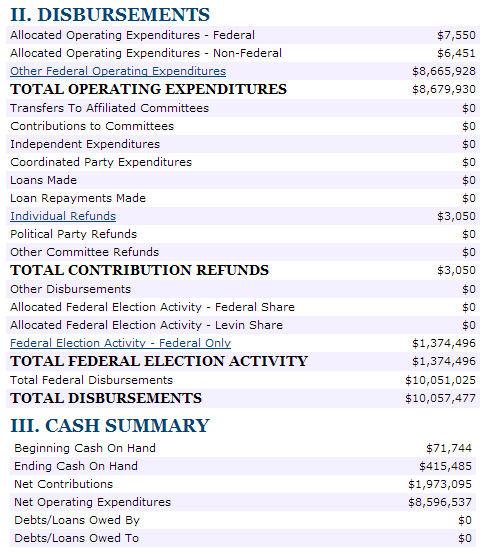
From my perspective, some of it has to do with where we chose to spend money in 2012 as well.  We can raise all the money in the world, but if it isn't put to effective use, it's nothing more than a tool buying our continued losses.

The Colorado Republican Committee summary page on TRACER for the 2012 election cycle, reflecting that $443,453.97 was spend in-state during that election cycle.


This picture and the previous picture are screen captures from the FEC website for the Colorado Republican Committee, reflecting the money spent on Federal (Presidential and Congressional) races and operating expenditures for 2012.

This shows the 2014 cycle (since 1 January 2013) on the FEC Website for the Colorado Republican Committee, reflecting operating expenditures for the cycle so far.

To look at these more in-depth, go to the TRACER website and search for committee number 19991500072, and the FEC website and search for committee number C00033134.

While I understand that Federal races tend to cost more money, are higher profile, and that they are indeed important, the State Party's first responsibility is to the State of Colorado.  We cannot keep sacrificing our state just to lose federal elections.  Colorado can't survive total Democrat rule any more than the country can, but we've allowed that to happen in this state because we focus our time and attention on national races.  Some of this is an education problem--let's face it, the undervote for down-ticket races is huge.  That doesn't make them any less important, as we are learning the hard way with the far-left agenda being jammed down Colorado's throat in the State Legislature right now.

I was recently reminded that we saw the highest delegate badge fees (at least in my recollection) this year, and candidates for President had to pay for the privilege of being on our non-binding straw poll ballot.  I wonder what the hard working and dedicated Republican activists who paid those increased fees think of having hundreds of thousands of dollars left unspent in perhaps the most critical election in the last century, if not our nation's history?  This one is none too happy.

For those who know me, you probably remember the hubbub I caused in El Paso County as the GOP Secretary for daring to disagree with a policy put forth by a State Legislator.  The horror!  You would think if someone did something that relatively minor (I dare you to find me any Republican I agree with 100%--even my husband and I aren't lock-step on policy issues), a Republican County Party Officer donating to a Democrat during his tenure would have gotten at least the same response--scorched earth, character assassination campaign, a gag order, censured... and at the very least, threatened with removal for actually violating the By-Laws in their letter (not just the spirit as folks argued against me), right?

Turns out, not so much.  In 2007, while the Vice Chair of the Denver County Republican Party, Chairman Ryan Call maxed out a contribution to Bernie Buescher, a Democrat candidate for State Representative out near Grand Junction.


My understanding, from talking to many active members of the Denver GOP at the time, is that no sanctioning action was taken, and Chairman Call certainly wasn't removed from office for his violation.  And, in the interest of fairness, Chairman Call then maxed out to the Republican in the race, Laura Bradford--so that makes everything okay, right?  Here's my question... why did he not ask for the contribution to Buescher back, at the very least?

We could move on and forgive an indiscretion, certainly.  It becomes much harder to do so when that rule is then unfairly applied.  This Party, I thought, believes in the rule of law--rules are rules and apply to everyone.  So, in 2010, why were Tancredo supporters not removed from their Party offices (even down to precinct leader)?  Why did Chairman Call take the position he did regarding my censure (on something that did not clearly violate the By-Laws, unlike an out-right contribution to a Democrat), saying one thing in public and another in private?  Why did Chairman Call participate in the removal of three precinct leaders from voting earlier this month at the Eagle County Republican Organizational Meeting... for doing the exact same thing he did, publicly support a non-Republican candidate?

I'm all about everyone getting to vote their conscience, and to support whom they choose--in fact, I encourage it.  I don't believe Party always trumps person (most of the time... almost all of the time, even... but not every time).  But there is a standard for Party officers--and we should hold all to it, or none to it.  It can't be arbitrarily applied.  That, at the very least, creates the appearance of a ruling class and a "rules for thee but not for me" mentality that is dangerous and not very Republican.

And speaking of Denver County... it is my understanding that Chairman Call, when he left the Denver GOP and subsequently became State Party Chairman, left a parting present of nearly $10,000 in debt.  It seems to me ironic that Chairman Call, who frequently makes a point of discussing the debt that the State GOP was in when he took over (and to the credit of those raising funds, was taken care of), left a similar problem for his successor.  Again, this could be overlooked, but from what others have told me, this is a pattern dating back to his days in the College Republicans.  Being hearsay, I won't go into the details shared with me until I can get some physical documentation.  Regardless of whether this is a one-time incident, or a series of unfortunate events, there is great irony considering how Chairman Call begins most speeches I've heard from him recently--that he dug the State GOP out of the same problem with which he left the Denver GOP.

Not that anyone is asking my opinion, but let me offer it anyways: my advise to win elections?  Let's start with don't donate to the "enemy", spend your resources wisely, and don't leave entities in debt.

21 February 2013

Opinion: More failure: Messaging, support, lies and the Colorado GOP

I frequently hear that "social issues are killing the Republican Party."  And while I personally would tend to take the libertarian approach to social issues (i.e. keep the government entirely out of them), I don't agree with that statement at all.  Social issues aren't killing this Party, how we message social issues (and just about everything else) is what is doing us in.

There is a fine line between candidates who get so distracted by everything thrown at them that they can't stay on message, and ultimately lose, and candidates who are so rigidly adherent to talking points they sound robotic, insincere, and fake, and ultimately lose.  Our Party has not done enough to help candidates message in their races, nor do they do enough to help amplify that message.

There are common themes to races at all levels: reducing the size and scope of the government, limiting taxes as much as possible, promoting the free markets rather than government solutions, focusing on the rule of law (not the rule of man), and most importantly, a great emphasis on personal responsibility.  With these themes applicable to everything from local utility board to US President, why has the Colorado Republican Party (and the Republican National Committee) continued to ignore their responsibility to make sure that candidates are well-trained and well-supported?

Under campaign finance law, the Colorado Republican Party is the only entity in this state that can coordinate on a large scale with all Republican candidates.  They can also contribute in much larger quantity to State Senate and House candidates ($20,500 and $14,805, respectively--this number is an aggregate between all political party donations, meaning County, State and National, this is per the SOS website).

What astounds me is not so much that the GOP hasn't gotten their messaging act together (if they continue to insist upon campaigning like it's 1980, why not continue to message like it's 30+ years ago, too?), but some in the Party bald-face lie about supporting candidates.

A current State Republican Party officer said last week at a public event that the reason they had approximately $300,000 left in the bank after Election Day was because they had maxed out to every Republican State House and Senate candidate in Colorado and there was nothing more they could do with it because campaign finance laws tied their hands.  Were it true that they had, indeed, maxed out to every Republican State House and Senate candidate, I can think of plenty they could have done with $300,000 myself, but I digress.  Except it is patently FALSE.
  1. In order to have maxed out to every Republican State House (65) and State Senate (20) candidate at the maximum allowed (assuming the County Parties didn't chip in at all), it would have cost the State Republican Party $1,372,325.  Considering they spent less than half that total in the State of Colorado on non-federal races, that would be mathematically impossible.
  2. A quick TRACER search shows that the Colorado Republican Party only contributed to 12 individual Republican candidates for State House or Senate directly out of 85.  That's only 14% of Colorado Republican State House or Senate candidates.  
  3. In my brief look at TRACER, only two candidates (Brian Watson and Amy Attwood) were given a maximum contribution, with another (Jennifer George) receiving almost a maxed-out contribution.  It looks like 2-3 more may have received the rest of the maximum after County Parties contributed as well.
In other words, very few got a "maxed out" contribution from the State Party, and certainly not all candidates.  

How can we advance any message when we can't even be honest with our Party members?  How are people supposed to trust the message we offer if they can't trust us to be honest about easily verifiable issues?

EDIT:
After a closer review of TRACER, the numbers above have been revised.  12, not 13, individual candidates received contributions directly from the Colorado Republican Committee, totaling $122,962.10.  There were 14 candidates in the "Trailblazers" program, two of which received no direct contributions from the Colorado Republican Committee: Rick Enstrom and  Ken Summers--which, again, pokes holes in the narrative that all Trailblazer candidates received contributions (they may have received indirect contributions, but nothing directly from the Colorado Republican Committee that I can find).

Here are the direct contributions candidates did received (mailers were done for several of these candidates through the "Colorado Republican Party Independent Expenditure Committee" which are not reflected in the numbers below--totaling $85,847.65, which when added with direct contributions only totals $208,809.75--short of the approximately $265,000 that Chairman Call has been saying was contributed to State Legislative Races, I'm unsure where the rest of the money, if there really was more, came from):
  • Cindy Acree, $4,931.22
  • Amy Attwood, $14,805
  • J. Paul Brown, $2,706
  • Larry Crowder, $6,968.13
  • Jennifer George, $14,804.44
  • Ellyn Hilliard, $5,000
  • Dave Kerber, $14,306.64
  • Dave Pigott, $5,000
  • Robert Ramirez, $10,142.90
  • Lang Sais, $19,500
  • Brian Vande Krol, $9,992.81
  • Brian Watson, $14,805
Of those candidates, only ONE won his election: Larry Crowder.  We lost sitting legislators Acree, Brown, and Ramirez, and lost all the other races (Attwood, George, Hilliard, Kerber, Pigott, Sais, Vande Krol, and Watson).

Edit #2: As you can see in the comments below, it has been brought to my attention that both Ken Summers and Rick Enstrom, while not receiving direct contributions from the CRC, took their contributions in coordinated expenditures.  I appreciate the correction, and when I have the chance, I'll take a look at TRACER so the numbers above can reflect this information.

16 February 2013

Editorial: It’s time for the Redprint

Wall Street Journal, 4 February 2013, “Party Eyes 'Red-State Model'to Drive Republican Revival

See that blue splotch in the center just to the left of the middle?  That’s what Colorado has looked like for almost a decade now.  We got “blueprinted” in 2004, and instead of leading the charge to counter the extremely effective model the Democrat Party used with Colorado as the test case, we’ve continued to remain a sickly blue every election cycle since (with the exception of the 1 seat majority in the State House brought on by the Tea Party surge of 2010).  It now takes a state, Kansas, with a supermajority and Republican control of the Governor’s office and both chambers of the State Legislature, to attempt to build a counter to that model—10 years later.

Since it started right here in Colorado, it should end right here in Colorado, but the Republican Party continues to do nothing about it

Why?  Why has the strategy not changed?  Why do we continue to use the same anemic top-down, Denver-centric model for campaigning?  Because there are people in power who benefit from our continued losses—and why not?  They continue to be paid to help us lose, to implement the same strategies that we’ve used for decades (with minor updates) that they think will somehow work again someday.

It’s time for a drastic shift and change in leadership, vision and strategy (all three of which have been entirely absent the last decade in the Colorado GOP).  Colorado is not the solidly-red state it once was.  We can’t continue to campaign like its 1980 and assume we will win like we always did.  Clearly, that isn’t working.  Instead of fixing it, we’ve kept the same model and suffered terribly for it for 10 years.  Enough is enough.

It’s time for the Redprint—in fact, it is long overdue.  After the abysmal showing in 2012, it should be clear to even the most hard-headed that what we have been doing simply isn’t working.  We need vision, strategy and leadership—not platitudes and pandering.  It’s hard to imagine we could do any worse than we did in 2012, and we can definitely do better.  But I don’t think we can do better without change at the top in Colorado. 

Ryan Call is a nice guy—but clearly, he is the wrong guy for this job.  As he said himself in December 2012 (and I’m paraphrasing), it wasn’t his job to lead, but to follow the dictates of the Romney campaign and the RNC.  What did that get us?  Losses across the board.

It’s great that we spent more money on State Legislative races than before, and nice that we raised $2.4 million.  But what did that buy us?  A very cushy salary for Chairman Call (after saying he wasn’t sure if the position should be paid on the campaign trail back in 2011).  Great kick-backs for all the crony political hacks who have ensured Democrat dominance in this state since 2004—people who are supposedly on our side!  Here’s what it also bought us:
  • A loss for Romney in Colorado.
  • A loss in our only statewide election. 
  • No change in Congress (despite a potential pick up in CD7).
  • No change at the CU Board of Regents (when there was one, possibly two, potential pick-ups).
  • No change at the State Board of Education (granted, with only CDs 2 and 4 up, there wasn’t likely to be any change this election cycle).
  • No change in the State Senate (despite 2 very winnable seats, and another possibility or two there).
  • A 9 seat swing in the State House, from 33R-32D to 37D-28R (the largest loss since 2004).

Additionally, Chairman Call guaranteed in 2011 that we would win in November 2012—or our money back.  Listen around the 12:30 mark to hear this pledge.


That $2.4 million raised?  That’s also helping to buy Chairman Call’s reelection.  From using Party fundraising letters and emails to promote his campaign (that is the only reasonable interpretation of several of those) to using Party Staff and resource to “select” Bonus Members to, apparently, using the new Regional Offices to all but bribe votes to refusing to share the contact information for the voting pool with other candidates for Chair, Vice Chair and Secretary, Chairman Call, in an unprecedented misuse of State Party funds and resources, is using your contributions to reelect himself.

If you are a contributor to the Colorado Republican Party, please ask for your contributions back and don’t contribute again until this gross misuse of Party resource is rectified.  This is inexcusable.

In 2011, Chairman Call made a number of campaign promises, including monthly meetings with Tea Party groups, providing needed resources to County Parties, to help County Parties fundraise, etc.  You can read the entire letter here.  To the best of my knowledge, he didn’t follow through on much, if any, of those. 

In the same letter, Chairman Call promises a transparent and accountable State Party, but we don’t even know what his salary is (rumor is that it is anything from $135,000-$175,000/year).  In fact, other than generic items on TRACER and the FEC, we don’t know where any of the $2.4 million raised (and over $7 million given by the RNC, Republican Senatorial Committee and Massachusetts GOP) was spent.  How is that transparent or accountable?

In 2007, while Vice Chair of the Denver County GOP, Chairman Call maxed out a contribution ($400) to Bernie Buescher, a Democrat candidate.  While I don’t have an issue with folks doing this, when you are a Party officer or official of any kind, that is unacceptable.  When he got caught, instead of doing the right thing, he made excuses.  He didn’t apologize, and he didn’t ask for his contribution back.  The explanation I have heard was that Ryan’s employer at the time (John Zackum—State Party Legal Counsel) asked him to, so he did—while they were Republican Party Officials, an offense that would get most people removed from their office (strangely enough, both Mr. Call and Mr. Zackum remained in their respective positions).

The bottom line is, we lost.  We lost badly.  We have not received an acknowledgement of that from Chairman Call, nor have we received an apology—and we’re not likely to.  We can’t keep winning when we keep using losing strategies.  We need a change.  It really can’t get any worse than total losses, but it can get better if we have a real leader focused on strategy and vision.  As nice as he is, that person isn’t Ryan.  For the good of the Party, he should have resigned on 7 November.  But he didn’t, and he won’t.  $135,000/year is an awful lot of money to give up easily, so I understand why he would fight for this—but without results, he doesn’t deserve that salary; he doesn’t deserve the job.

07 November 2012

Editorial: The Aftermath

Or, perhaps better titled... "A Little 'I Told You So' and a Little 'You Were Right'".

After I put out my predictions on Colorado races (especially the Colorado State House), many people went nuts saying I was super pessimistic, only doomsday would bring those numbers, we were going to gain several seats in the House and win the Senate, etc.  Well, some of you were right about one thing... I was wrong on my numbers.  However, I think I've earned the right for a bit of a (maybe even a big) 'I told you so!' because my numbers about the Democrat sweep of the Colorado State House were low, not high.  In fact, of all the electoral prognostications I saw, no one else right-of-center predicted a net Democrat gain in the State House, let alone the near-total sweep that happened (I didn't look at things like Colorado Pols or other places like that, so I don't know what the left-of-center folks were saying).

So what happened?

One word.  REAPPORTIONMENT.

Two words.  Ryan Call.

Three words.  Republican 'Leadership' Vacuum.  (referring to the counties, since State Party is covered previously)

That's my election summary for Colorado.  The party of evil cannot be beaten by the party of stupid, and it's more stupid than usual here in Colorado.  Remedies?

  1. Run the so-called 'leadership' out of town on a rail.  February and March will be upon us before we know it, and we MUST clean our (GOP) own house before we worry about anything else.
  2. Once we have actual leadership, better candidates.  Not these simpering, moderate, big-government boo-hoo Boehner sissy-types, but people who actually believe in liberty and the GOP platform--and aren't afraid to talk about it, advocate effectively, and are actual competent candidates.
  3. We need a long-term strategy.  Living election cycle to election cycle, with a year and a half of down time between elections DOESN'T CUT IT.  At minimum, we need a 10 year strategy in place within the next 6-12 months.  We won't win everything overnight.  We have to be realistic.  But for crying out loud, we need to plan.  Failing to plan is planning to fail.


PRELIMINARY RESULTS

The results will not be official for a while longer, but I don't think (other than possible one race: SD19) that the results will drastically change between now and when the official results are released.  Not enough to change who wins, at any rate.  Below are the winners as of right now from the Secretary of State's results page (I'll add in percents later when they are official).  If they're in bold, I got that race right.  If they are in italics, I got that race wrong.  Not all counties have reported into it yet.


CU Regent
Pre-Election Make-up: 5 Republicans, 4 Democrats
Projected Post-Election Make-up: 5 Democrats, 4 Republicans
Post-Election Make-up: 5 Republicans, 4 Democrats
  • At-Large: Steve Ludwig (Democrat)
  • Congressional District 3: Glenn Gallegos (Republican)
  • Congressional District 5: Kyle Hybl (Republican)
  • Congressional District 7:  Irene Griego (Democrat)
3/4


State Board of Education
Pre-Election Make-up: 4 Republicans, 3 Democrats
Projected Post-Election Make-up: 4 Republicans, 3 Democrats
Post-Election Make-up: 4 Republicans, 3 Democrats

2/2

Congressional
Pre-Election Make-up: 4 Republicans, 3 Democrats
Projected Post-Election Make-up: 4 Republicans, 1 Democrat, 2 toss-ups (my bet is at least one, CD7, goes R)
Post-Election Make-up: 4 Republicans, 3 Democrats
*Quick note on the two toss-up: I never said Kevin Lundberg or Joe Coors would win, only that they could win (and I do have to admit surprise with the defeat of Coors by the numbers I'm seeing).  Under better leadership in this state, they very well may have won, but speculating doesn't get us anywhere.  Bottom line, while I'm surprised by the margin of defeat that Coors suffered, I'm not terribly surprised either district did what it did.  I'm giving myself half credit for each of these, though, to be fair.

6/7


State Senate
Pre-Election Make-up: 20 Democrats, 15 Republicans
Projected Post-Election Make-up: 16 Democrats, 15 Republicans, 4 toss-ups (my guess is it goes 2 and 2 for Republicans and Democrats)
Post-Election Make-up: 20 Democrats, 15 Republicans
*Okay, on this one, I was wrong.  I actually thought Lang Sais would win outside the margin of an automatic recount.  While this race is within the margin of automatic recount now (I believe 332 votes are separating them), I'm not sure that Lang can make up that many votes.

**Partial credit to me on this one for leaving it a toss-up and not doing with it what I did with SD19, because I thought about it originally.  I am a little surprised that Newell won, to be honest, but not totally shocked.

***There are two counties yet to complete reporting in this race according to the SOS site, and about 1,000 votes separating Crowder and his opponent, so it may tighten, but I don't think he'll end up losing.

18.5/20


State House
Pre-Election Make-up: 33 Republicans, 32 Democrats
Projected Post-Election Make-up: 30 Democrats, 28 Republicans, 7 toss-up (my very unscientific prediction is all but 1 or 2 go Democrat based on district performance and/or active voter registration numbers, and what I know about the district and candidates)
Post-Election Make-up: 37 Democrats, 28 Republicans
*Not giving myself any credit for it, but I was right that Ellyn Hilliard did have the largest number of votes for a Republican in Boulder State House races.  Just sayin'.

**Partial credit for this one since I gave no clear prediction.

***My bad for not making this one a toss-up, I was truly surprised that J. Paul Brown lost that district with the numbers I saw.

****My only surprise in this race was Kathleen Curry not getting more votes than she did.

I'm not really surprised by any of this (other than J. Paul Brown losing, that one did catch me off guard), but I am somewhat surprised by the margins I'm seeing.  For example, I expected Robert Ramirez to lose, but not by near 10%.  Just goes to show the power of reapportionment.

63.5/65


FINAL RESULTS

Bottom line, reapportionment really shanked us.  I was overly-optimistic about the State Senate, and under-pessimistic about the State House.  Finally tally?

Out of 94 races in which I predicted an outcome, I only got 3 out and out wrong; 4 races I characterized as toss-ups (either not making a clear predictions one way or another, or which I called as "leans" the wrong way (but still kept it as a toss-up).  That equals a 96.81% accuracy rate.  Not too bad for relying solely on the three things I have always found to be the most reliable indicators in politics:
  1. Active Registered Voters,
  2. Past District Performance, and
  3. Good ol' gut instinct (which is largely based on knowing many of the districts and candidates).
No polls, no "how much money was raised", no gimmicks.  Just saying, folks.  Just saying.

Oh, and I more than once predicted Obama would win Colorado.  In fact, that was the best possible thing (well, actually, the best possible thing would have been Obama winning Colorado but losing nationally), because that is a slap in the face to the Ryan Calls and Eli Bremers and other GOP hacks of the world.  Guys, you didn't win it.  You and your ilk have now fudged up what should have been two wave Republican years (2010 and 2012), and you still haven't gotten it through your back-room, smoke-filled brains that we can't fight the party of evil with your brand of stupidity and lack of strategic vision.  

Maybe the rest of the Colorado GOP will now get the hint to make that kind of Republican 'leadership' extinct.  This isn't about radically changing the Party, this is about using common sense, a solid platform actually adhered to by candidates, and basic political strategy to actually... you know... win elections.  Liberty is a winning message, guys.  Get on the bandwagon or get off at the next stop (heck, we might even throw you off before we get to the next stop depending on how you respond to this repudiation of your inability to "make Colorado red again").