Showing posts with label Republican. Show all posts

26 August 2016

The Value of Bi-Partisan Support for School Choice

This post is part one in a series of three posts on school choice focusing on value: the value in true bi-partisan support of an issue, the inherent value in choice, and the ultimate value in education.  Check back on 9 & 23 September for parts 2 & 3, respectively.

School Boy, Education

In politics, there are two phrases we hear often: “bi-partisan support” and “it’s for the kids!

Often these are barely lip service, trying to spin focus on an issue that generally has neither real bi-partisan support nor any real effect on children, but on one issue in particular, both couldn’t be more true.  School choice is an issue that transcends party lines and truly is for the kids.

While some on the left would focus in the “village” they claim is needed to raise children, and some on the right would focus myopically on which specific “choice” is best, a band of parents, school board members, and state legislators are setting aside other differences to increase opportunities for all children.

At the Denver Amplify School Choice Conference in August 2016, a panel discussion between Dr. John Evans (former Republican State Board of Education At-Large member and State Senator) and Rep. Angela Williams (Democrat) shared their perspectives on the truly bi-partisan support for school choice in Colorado and nationwide.

Rep. Williams said that the purpose of the legislature getting involved in school choice is to enhance student achievement, allow for innovative methods of instruction, provide resources for local school governance, and provide parents with alternatives.

Rep. Williams highlighted the legislature's role in education as providing funding, ensuring that all students receive a high-quality education, and ensure that ALL students have equal opportunity to attend high-quality schools no matter their zip code.

Angela Williams quote, school choice

Rep. Williams was co-sponsor of three bills to make headway in leveling the playing field for charter schools in 2016: SB16-187 and SB16-188 (both of which died in committee, but were largely incorporated into the School Finance Act, HB16-1422, which passed), and SB16-208, which became law.

In July 2016, the NAACP proposed a resolution at their national convention that was later adopted by their Board calling for a “moratorium on charter schools”.  Rep. Williams, a member of the NAACP responded to this proposal with a forceful proclamation: “I’m not going to stand by and send our children to failing schools.

Highlighting another area where bi-partisan support of charter schools has made a significant impact, Dan Schaller of the Colorado League of Charter Schools gave a presentation highlighting the success of charter schools in traditionally liberal Denver, Colorado; focusing in particular on the largely cordial relationships between charter schools and the Denver Public Schools Board.

A lot has changed over the past decade for Denver Public Schools (DPS), in large part thanks to the increase of charter schools and the unique relationship they enjoy with the school board in Denver.

Issue
Mid-2000s
2016
Academic Growth
Lowest rate of AG in all mid-to-large CO School Districts
Highest rate of AG in mid-to-large CO School Districts since 2012
Growth Rate
Out of 98,000 available seats, 31,000 (32%) were empty

Timely Graduation
Less than 39% of students graduate high school on time
65% of students graduate high school on time (166% increase)
In-District Schooling
Just under 25% of students left for other districts or options, costing DPS $125m annually
Fastest growing urban school district in the country
Grade Level Performance
33% in 2006
48% in Fall 2014
Additional Issues
DPS now…
·    …sends 48% of their high school graduates to college
·    …has 1 in 7 low-income students go to college (state average is 1 in 20)
·    …has closed or replaced 48 underperforming schools and opened 70 new schools (mostly charter) since 2005
·    …has a SchoolChoice universal enrollment system which makes it easier for parents to choose their child’s school (in or out of district)
·    …sends over 18% of their students to charter schools

In Denver, bi-partisan support was critical to these successes.  A message-neutral tone, such as focusing on quality schools rather than the type of school, creating results and not being about choice just for choice’s sake, and focusing on the results for the kids being the ultimate goal, not how or where the results were created, built the foundation for progress in a traditionally hostile environment.  Additionally, a focus on pacing progress (sometimes slower to gain in the long run), creating equity (rather than equality), and pursuing autonomy and accountability within the district breeds trust and builds valuable relationships.

Without bi-partisan support, kids will continue to lose.  Focusing on the value of gaining and sustaining that support is key to providing quality education to all children and options to all parents.  It is, after all, for the kids.

03 March 2015

Opinion: 50 Shades of Ryan Call (He's Just Not That Into You)

If "corruption" was a color, we'd need more than 50 Shades for this post.


I have, thus far (and surprisingly successfully), stayed almost entirely out of the 2015 Colorado Republican Chairman's race.

It's no secret that Ryan Call and I aren't exactly friendly (I am, after all, on his enemies list), and that I supported and voted for Steve House at State Assembly for Governor in 2014.  Needless to say, this one is a no-brainer for me.  But without a vote on March 14, it seemed unnecessary for me to step in and rehash so many old things... until now.

This past weekend was the final straw for me, and for many in the Colorado GOP.  Many have continued to come back over and over to someone who has continually thumbed his nose at us, but it's time to make a clean break once and for all.

Before we do that, however, let's see what built up to this moment.  Yes, it's snarky and sarcastic, but solidly based in reality (as you'll see with all the links and endnotes).  Did you really expect anything else from me?  At this point, the joke is on all of usall Colorado Republicans, and we're all losing because of it.  Sometimes you have to fight fire with fire.  Enough is enough.

Join me (and those signed below) in breaking up with Ryan Call—and if you're bold enough, let me know and I'll add your name to this letter, too (man or woman... unlike Ryan Call, I won't discriminate based on gender).

If Call wins, Colorado loses.  It's that simple.


From the Desk of
Colorado Republican Women

March 3, 2015

Our dear Chairman Ryan Call,

We’ve been together for almost 4 years now.  Maybe it’s time to think about where we are at, and what we have accomplished in our relationship.

The Colorado Republican Party has made some improvements.  We’re now caught up to the early 2000s in technology, as opposed to dwelling in the 1980s dark ages... so there’s that. 

We applaud you for your attempt at building an infrastructure, such as it is, but with nothing there before, it’s a good place to start.

However… not everything has been so rosy.

I mean, we might have been able to overlook your $400 maxed-out contribution in 2006 to Bernie Buescher (screenshots here), a Democratic candidate, while you were Denver County Republican Party Vice Chair… if you didn’t threaten to withhold money from viable Republican candidates because they didn’t pick a company you liked to work with them on their campaign.

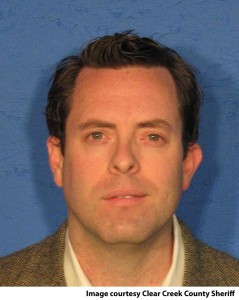
We could forget your lovely 2011 mug shot—from a traffic ticket you managed to forget to show up to court for… as a lawyer—if you weren’t funneling tens of thousands of Colorado Republican Committee dollars to your own law firm[1].

It would be possible to forget that you threw two Republican state legislators (Sen. Vicki Marble and Rep. Lori Saine) under the bus… if you didn't admonish the entire House and Senate Republican delegation over opposing in-state tuition for illegal aliens (in clear opposition to the Party platform[2]).

We could turn a blind eye to your pathetic and paltry support of state legislative candidates[3, 4]… if only your pet IEC hadn’t just been found guilty of violating state law on 4 counts—while you are a member of the RNC Finance Committee, and after you trumpeted on the radio that the “independent” committee was, in fact, coordinating with the Republican Party after all.

Maybe we could live with all the secrecy and non-transparency of your entire administration if you didn’t hire a convicted crook to run your new IEC.  I mean… you let someone guilty of federal crimes into our home?  We thought you cared more about our safety, credibility, and integrity as a Party than that.

Speaking of money… you promised us back in 2011 that we would win in November 2012, or our money back—guaranteed!  Here’s what over $8 million (mostly given to you by the blood, sweat, and tears of the RNC, and not from your own shoe leather) bought us in 2012:
  • A loss for Romney in Colorado.
  • A loss in our only statewide election.
  • No change in Congress (despite a potential pick up in at least one district).
  • No change at the CU Board of Regents (when there were two potential pick-ups).
  • No change at the State Board of Education (granted, with only CDs 2 and 4 up, there wasn’t going to be any change this election cycle).
  • No change in the State Senate (despite two very winnable seats, and two more toss-ups).
  • The largest loss in the State House, from 33R-32D to 37D-28R, since 2004—the year of The Blueprint.

Oops.  That was kind of embarrassing.  Let’s move on to something better, shall we?   Like 2014.  This past election, we saw…
  • A loss for Beauprez; but wins for 3 other statewide Republicans.
  • No change in Congress; but a win for Gardner.
  • No change at the CU Board of Regents.
  • No change at the State Board of Education.
  • A 1-seat (net) gain in the State Senate (18R/17D)—could have been 3 net wins.
  • A 3-seat gain in the State House (34D/31R)—could have been 6 wins.


That’s a little more positive, isn’t it?  Slow clap on winning one national race while largely letting the rest of the state stay stagnant.

Look.  We might be able to applaud your minimal gains for Republicans in Colorado after 2 terms and nearly $20 million dollars spent on elections[5]… if only registration for active Republicans hadn’t dropped by 5.49% under your tenure, with an overall drop of 1.29% of total registered Republicans during that time[6, 7].

And then there’s your statement on October 7, 2013 about the Senate District 19 recall (“This recall election would undermine our efforts in the governor’s race, the U.S. Senate race and to win a senate majority if voters perceive that Republicans are trying to win a majority through recalls.” [source]).  Now, this we might forgive and forget if it wasn’t just so blatantly wrong—after all, we did win the U.S. Senate seat and the State Senate majority… only and entirely because this seat was up for election in 2014.  This is, of course, after you opposed the ruling that made success even possible in the Senate Districts 3 and 11 recalls… and then tried to cover that up by removing the press release from your website.

Here’s the rub.  There’s a lot we are willing to turn a blind eye to in the name of “unity”.  There’s even a lot that we think can, and should, be kept behind closed doors. 

The problem, Mr. Chairman, is that nothing ever gets resolved behind closed doors because you pretend like we don’t exist.  Let’s face it.  You have a very poor track record of dealing with us women.  I mean, just look at the numbers:
  • 4/30 female candidates in 2014 received State Party support
  • 5/24 female candidates in 2012 received State Party support
  • A mere 14% of funds given to candidates in 2012 and 2014 went to women, who made up almost 1/3rd of all candidates for statewide and state legislative offices

And yet, despite all that, we stayed steadfast, loyal, and true.  But no more.

The final straw, Mr. Chairman, was the transparent and blatant power grab just this past weekend in Costilla County, where you chose to unseat duly elected officers and replace them with your handpicked voters.  We are willing to tolerate a lot, but you finally crossed a bridge too far and we just can’t do it anymore.

We’re not asking for special treatment.  We’re not even asking for the same treatment you give to men.  All we want is a little bit of fair play.  Is that really so much to ask?

It’s time for us to face the truth.  You’ve shown that you’re not that into us. 

Well… guess what?  That feeling is mutual. 

We’re just not that into you, either. 

And no… we can’t be ‘just friends.’  We’re through.


Disaffectionately,

Colorado Republican Women
Sarah Arnold, Regan Benson, Meaghan Croghan, Sharon Croghan, Lana Fore, Mary Anne Greer, Leslie Hanks, Alexandra Harden, Judy Howell, Tina Jones Griffiths, Dorié Ann Lehan, Becky Mizel, Julie Naye, Jen Raiffie, Mailyn Salabarria, Julie Scott, Anita Stapleton, Nancy Wenlock

And the men who love Colorado Republican women...
Matt Arnold, George Athanasopoulos, Kim Herzfeld, William Howell, Simon Kane, Robert Pryor, Joe Webb


__________________

END NOTES

[1] $147,225.00 from 2011-current paid to Hale Westfall LLP by the Colorado Republican Committee. Search committee #C00033134.

[2] “Illegal immigrants should not receive any non-emergency benefits, services or privileges from federal, state or local governments.” [source]

[3] 28.66% of CRC funds, according to TRACER, went directly to non-federal candidates in 2012. 62.41% of CRC funds, according to TRACER, went directly to non-federal candidates in 2014—a number which drops dramatically to a mere 14.85% when you remove contributions to gubernatorial candidate Bob Beauprez. Search committee #19991500072.

[4] CRC money spent in the state of Colorado in 2012 on non-federal elections was 4.41% of the total operating budget that cycle. CRC money spent in the state of Colorado in 2014 on non-federal elections was 8.04% of the total operating budget that cycle. See notes 1 and 3 to find committee information on TRACER and FEC.
        In other words, 1.21% of total CRC money was spent on non-federal candidates in 2012; and only 4.65% of total CRC money was spend on non-federal candidates in 2014… or 1.11% if you take out Beauprez’s contributions.

[5] 64 Republicans in statewide and federal office in 2011 vs. 66 Republicans in statewide and federal office in 2015 (out of 130).

[6] 38.33% active registered Republicans as of 1 April 2011, 32.69% total registered Republicans as of 1 April 2011 [source]

[7] 32.84% active registered Republicans as of 1 February 2015, 31.40% total registered Republicans as of 1 February 2015 [source]

01 February 2015

Spoiler Alert! and "Close" Elections

Taken from here.

Of 101 Colorado races in 2014, only 9 races had "spoilers" (races where the winner had less than 50%).  And of those races, only 4 resulted in a Democratic victory.  That means 4% of Colorado races were "adversely" affected by third party candidates (if you're a Republican).

U.S. Senate: Cory Gardner (Republican), 48.21%
Governor: John Hickenlooper (Democratic), 49.30%
Secretary of State: Wayne Williams (Republican), 47.34%
Treasurer: Walker Stapleton (Republican), 49.87%
Senate District 5: Kerry Donovan (Democratic), 49.04%
Senate District 19: Laura Woods (Republican), 47.61%
Senate District 20: Cheri Jahn (Democratic), 46.81%
House District 17: Kit Roupe (Republican), 47.27%
House District 29: Tracy Kraft-Tharp (Democratic), 49.40%

Taken from here.

Additionally, there were 15 races where the margin of victory was within 3.5%, which one could consider to be "toss-up" seats (close enough that they can go either way in the right election circumstances).

U.S. Senate: 1.95% (39,688 votes)
Governor: 3.35% (68,238 votes)
Secretary of State: 2.36% (46,525 votes)
Senate District 5, 3.31% (1,301 votes)
Senate District 16, 2.74% (1,897 votes)
Senate District 19, 1.05% (663 votes)
Senate District 20, 0.62% (439 votes)
Senate District 22, 2.24% (1,336 votes)
Senate District 24, 1.74% (896 votes)
House District 3, 1.46% (443 votes)
House District 17, 2.02% (289 votes)
House District 30, 0.56% (106 votes)
House District 31, 0.98% (229 votes)
House District 36, 2.90% (668 votes)
House District 59, 0.50% (170 votes)

8R/7D

Taken from here.

What does all this mean?

  1. "Spoilers" actually work in favor of Republicans, too, so quit yer whining.
  2. There were a number of fairly close election in 2014--this was the Republican's year to lose, and lose they did in Colorado... way too often.  Infinitely winnable seats slipped through our grasp once again.

94%: The 2014 Election Wrap-up Post

Sorry for the long delay on this--family life and work have been a little nutty since the election.

Taken from here.

Okay, so it isn't the 97% of 2012.  But I'll take it.  Especially because, once again, Nate Silver isn't better than me (we tied this time, counting his U.S. Senate Predictions).

This election was not decided on Election Night in Colorado.  Had we gone based on Election Night results, Colorado would now have a Republican Governor, a 20R-15D Senate Majority, and a 33R-32D House Majority.  That... didn't exactly happen, now did it?

This is why early returns are, frankly, unimportant!  I watched way too many people get their hopes up.  That smashing 7%+ victory for Cory Gardner on Election Night?  It was actually just under 2%.  It wasn't a blowout.  Beauprez winning?  Nope.  He lost by 3.35%.  Taking the State House?  Ha... no.  And we barely have a Senate Majority.  Don't forget that it took weeks for Adams County to finish counting, and that there was one seat within the margins for an automatic recount in Southwest Colorado (House District 59), although the ultimate result there didn't change.

Below is a brief review of the final election results.  Results may be found on the Secretary of State's website.

Legend:
Bold denotes incumbent
Italic indicates an incorrect call
Red shows a Republican Pick-up
Blue delineates a Democratic Pick-up
Races with no-call are green

Statewide

Pre-Election Make-up: 3 Republicans, 3 Democrats
Projected Post-Election Make-up: 4 Democrats, 2 Republicans 
Post-Election Make-up: 4 Republicans, 2 Democrats
Seats up: 5
  • U.S. Senate (class 3): Cory Gardner (Republican)
  • Governor: John Hickenlooper (Democratic)
  • Attorney General: Cynthia Coffman (Republican)
  • Secretary of State: Wayne Williams (Republican)
  • Treasurer: Walker Stapleton (Republican)
3/5

Congressional

Pre-Election Make-up: 4 Republicans, 3 Democrats
Projected Post-Election Make-up: 3 Republicans, 3 Democrats, 1 toss-up
Post-Election Make-up: 4 Republicans, 3 Democrats
Seats up: 7
  • Congressional District 1: Diana Degette (Democratic)
  • Congressional District 2: Jared Polis (Democratic)
  • Congressional District 3: Scott Tipton (Republican)
  • Congressional District 4: Ken Buck (Republican)
  • Congressional District 5: Doug Lamborn (Republican)
  • Congressional District 6: Mike Coffman (Republican)
  • Congressional District 7: Ed Perlmutter (Democratic)
6/6, 1 toss-up

CU Regent

Pre-Election Make-up: 5 Republicans, 4 Democrats
Projected Post-Election Make-up: 5 Republicans, 4 Democrats
Post-Election Make-up: 5 Republicans, 4 Democrats
Seats up: 3
  • Congressional District 2: Linda Shoemaker (Republican)
  • Congressional District 6: John Carson (Republican)
  • Congressional District 7: Irene Griego (Democratic)
3/3

State Board of Education

Pre-Election Make-up: 4 Republicans, 3 Democrats
Projected Post-Election Make-up: 4 Republicans, 3 Democrats
Post-Election Make-up: 4 Republicans, 3 Democrats
Seats up: 3
  • Congressional District 1: Valentina Flores (Democratic)
  • Congressional District 3: Marcia Neal (Republican)
  • Congressional District 7: Jane Goff (Democratic)
3/3

State Senate

Pre-Election Make-up: 18 Democrats, 17 Republicans
Projected Post-Election Make-up: 18 Democrats, 16 Republicans, 1 toss-up
Post-Election Make-up: 18 Republicans, 17 Democrats
Seats up: 18
  • Senate District 1: Jerry Sonnenberg (Republican)
  • Senate District 2: Kevin Grantham (Republican)
  • Senate District 3: Leroy Garcia (Democratic)
  • Senate District 5: Kerry Donovan (Democratic)
  • Senate District 6: Ellen Roberts (Republican)
  • Senate District 7: Ray Scott (Republican)
  • Senate District 9: Kent Lambert (Republican)
  • Senate District 11: Michael Merrifield (Democratic)
  • Senate District 13: John Cooke (Republican)
  • Senate District 15: Kevin Lundberg (Republican)
  • Senate District 16: Tim Neville (Republican)
  • Senate District 19: Laura Woods (Republican)
  • Senate District 20: Cheri Jahn (Democratic)
  • Senate District 22: Andy Kerr (Democratic)
  • Senate District 24: Beth Martinez-Humenik (Republican)
  • Senate District 30: Chris Holbert (Republican)
  • Senate District 32: Irene Aguilar (Democratic)
  • Senate District 34: Lucia Guzman (Democratic)
15/17, 1 toss-up

State House

Pre-Election Make-up: 37 Democrats, 28 Republicans
Projected Post-Election Make-up: 36 Democrats, 29 Republicans
Post-Election Make-up: 34 Democrats, 31 Republicans
Seats up: 65
  • House District 1: Susan Lontine (Democratic)
  • House District 2: Alec Garnett (Democratic)
  • House District 3:  Daniel Kagan (Democratic)
  • House District 4: Dan Pabon (Democratic)
  • House District 5: Crisanta Duran (Democratic)
  • House District 6: Lois Court (Democratic)
  • House District 7: Angela Williams (Democratic)
  • House District 8: Beth McCann (Democratic)
  • House District 9:  Paul Rosenthal (Democratic)
  • House District 10: Dickey Lee Hullinghorst (Democratic)
  • House District 11: Jonathan Singer (Democratic)
  • House District 12: Mike Foote (Democratic)
  • House District 13: K.C. Becker (Democratic)
  • House District 14: Dan Nordberg (Republican)
  • House District 15: Gordon Klingenschmitt (Republican)
  • House District 16: Janak Joshi (Republican)
  • House District 17: Kit Roupe (Republican)
  • House District 18: Pete Lee (Democratic)
  • House District 19: Paul Lundeen (Republican)
  • House District 20: Terri Carver (Republican)
  • House District 21: Lois Landgraf (Republican)
  • House District 22: Justin Everett (Republican)
  • House District 23: Max Tyler (Democratic)
  • House District 24: Jessie Danielson (Democratic)
  • House District 25: Jon Keyser (Republican)
  • House District 26: Diane Mitsch-Bush (Democratic)
  • House District 27: Libby Szabo (Republican)
  • House District 28: Brittany Pettersen (Democratic)
  • House District 29: Tracy Kraft-Tharp (Democratic)
  • House District 30: JoAnn Windholz (Republican)
  • House District 31: Joe Salazar (Democratic)
  • House District 32: Dominick Moreno (Democratic)
  • House District 33: Dianne Primavera (Democratic)
  • House District 34: Steve Lebsock (Democratic)
  • House District 35: Faith Winter (Democratic)
  • House District 36: Su Ryden (Democratic)
  • House District 37: Jack Tate (Republican)
  • House District 38: Kathleen Conti (Republican)
  • House District 39: Polly Lawrence (Republican)
  • House District 40: John Buckner (Republican)
  • House District 41: Jovan Melton (Democratic)
  • House District 42: Ronda Fields (Democratic)
  • House District 43: Kevin Van Winkle (Republican)
  • House District 44: Kim Ransom (Republican)
  • House District 45: Patrick Neville (Republican)
  • House District 46: Daneya Esgar (Democratic)
  • House District 47: Clarice Navarro-Ratzlaff (Republican)
  • House District 48: Stephen Humphries (Republican)
  • House District 49: Perry Buck (Republican)
  • House District 50: Dave Young (Democratic)
  • House District 51: Brian DelGrosso (Republican)
  • House District 52: Joann Ginal (Democratic)
  • House District 53: Jeni Arndt (Democratic)
  • House District 54: Yeulin Willett (Republican)
  • House District 55: Dan Thurlow (Republican)
  • House District 56: Kevin Priola (Republican)
  • House District 57: Bob Rankin (Republican)
  • House District 58: Don Coram (Republican)
  • House District 59: J. Paul Brown (Republican)
  • House District 60: Jim Wilson (Republican)
  • House District 61: Millie Hamner (Democratic)
  • House District 62: Ed Vigil (Democratic)
  • House District 63: Lori Saine (Republican)
  • House District 64: Tim Dore (Republican)
  • House District 65: Jon Becker (Republican)
63/65

29 October 2014

The Reformation and Millennials: What Does This Mean? (Part 4)

This presentation was given at the Weld County Republican Breakfast on 29 October 2014, and has been modified slightly to make sense in this format (there are a lot more pictures in the linked PowerPoint).

Please read Part 1, Part 2, and Part 3 first.


What Does This Mean?

In Luther’s Small Catechism, every Commandment is followed up by the question, “What does this mean?” This may seem a disjointed and unrelated talk. An event almost 500 years ago and a generation of young adults today? But there is a distinct connection, at least that I see.

The Reformation changed not only the church, but the world. We can do the same in politics (changing our country, and affecting the whole world) if we really focus. 

While millennials are the least religious generation in American history, those that are religious are longing for something with some roots and history. The GOP can fill that political longing in the same way that High Churches can fulfill their theological longing. But that means we as Republicans needs to stand firm. And that’s where the new (political) Reformation comes in.


New (Political) Reformation

It’s time for us to write our own 95 Theses and nail those on the Republican National Committee and Colorado Republican Committee doors in Washington and Englewood. It’s time the Party knows that we are serious


We believe in limited government, but Republicans are voting to raise the debt ceiling and for new taxes.

We believe in individual rights, but Republicans are voting to invade our privacy in ways we can’t even imagine.

We believe in property rights, but Republicans are voting to take away our property through eminent domain and asset forfeiture.

We believe in family values, but Republicans all over are watering down and moderating our message.

We believe in the value of life, but Republicans hide from that issue when it’s politically inconvenient for them.

We believe in the freedom of association, but Republicans are investigating bakers who turn down a customer.

We believe in the right to protect ourselves, our loved ones, and our property, but Republicans compromise under political pressure on that most fundamental of rights.

We believe in the rule of law, but Republicans give themselves special favors and exemptions as elected officials, seeing themselves as above the law and not one of the hoi polloi.

We believe in liberty, but Republicans chip away at that day by day.

On and on and on I could go. I bet you are thinking of areas I missed already. My point now is not to get a full, perfect list, but to say this… that Republicanism, as a brand, is no longer credible

It is up to us to rebuild that trust and reclaim our brand… or go our separate way and let them die the death of the Whigs.


Please note: all pictures were found via google image search, all I did was crop and add text.

The Reformation and Millennials: What Does This Mean? (Part 3)

This presentation was given at the Weld County Republican Breakfast on 29 October 2014, and has been modified slightly to make sense in this format (there are a lot more pictures in the linked PowerPoint).

Please read Part 1 and Part 2 first.


Messaging in Politics

I was at fundraising training at the Leadership Institute in Washington DC last month, and we talked a lot about communication, especially right vs. left brained communication.

Left Brain

  • Intelligence 
  • Logic 
  • Thinking 
  • Short term memory 
  • Conscious awareness 
  • Language reasoning 
  • Problem solving 

Right Brain

  • Motivation 
  • Creativity and intuition 
  • Feelings and emotions 
  • Long term memory 
  • Subconscious mind 
  • Music and jingles 
  • Suggestion
I often say that I am so far left brained, I can’t see right brained. I’m very process-oriented, math-oriented, and so not creative. And, honestly, this is the story with a lot of those right of center. But we have to remember that…
  • Voting is an a-rational act 
  • Right brain is the motivator, left brain is the rationalizer 
  • Conservatives appeal to the left brain… 
  • …but the seat of motivation is the right brain! 
  • The better you can communicate to the right brain, the more you will motivate someone to take action!


Messaging to Millennials

DON’Ts

  • Don’t talk down. 
  • Don’t let them know that you know it all. 
  • Don’t pander. 
  • Don’t be inconsistent.  
  • Don’t be a hypocrite. 
Remember: Millennials are the first generation to grow up with microtargeted advertisement from a very young age – they know how to spot BS when they hear it.

DOs

  • Do be honest
  • Do be upfront
  • Do be concise – remember, these folks have an attention span of 140 characters.
  • Do appeal to both sides of the brain
  • Do stand your ground
  • Do realize you aren’t going to change someone’s opinion on the first contact or overnight
  • Do build credibility by building a relationship


How to Talk Social Issues

Here are some general ideas to remember when forming your plan to talk about social issues with the “Me” generation:

Do not start out by talking about religion – social issues are moral issues first, not necessarily faith issues. Millennials are the least religious generation in American History.

Ask questions first – and listen. You’ll surprise them. Millennials want to be heard and understood… like everyone else.

Understand that millennials’ education has been drastically more liberal than previous generations. You have to cut through all of that before you can get to the meat of the issue.

Understand that millennials are accustomed to instant gratification. If you can’t provide instantaneous results, they are going to be less interested.

Access to information is much more readily available to millennials than any other generation before. They can fact check, and probably in the palm of their hand, so be precise!

Be ready and willing to agree to disagree, and not argue minutia. Go in with the understanding that you will not come out with 100% agreement.

Follow up. Planting seeds now can reap significant fruits in 1, 5, or even 10 years.

Finally, this is the narcissistic generation. Convincing them that they are wrong is a long-term project. Be ready to invest some time in this endeavor.


Continued in Part 4.


Please note: all pictures were found via google image search, all I did was crop and add text.

The Reformation and Millennials: What Does This Mean? (Part 2)

This presentation was given at the Weld County Republican Breakfast on 29 October 2014, and has been modified slightly to make sense in this format (there are a lot more pictures in the linked PowerPoint).

Please read Part 1 first.


Millennials

A “millennial” is defined on Wikipedia as “the demographic cohort following Generation X. There are no precise dates when the generation starts and ends. Researchers and commentators use birth years ranging from the early 1980s to the early 2000s. ([They are] also known as the Millennial Generation or Generation Y).”

Before we get into the political aspect, let’s bridge that gap with a look at millennials in the church.


Millennials in the Church

I have a few quotes I’d like to share on this topic from three different articles published last year. I want you to pay careful attention, because as with most of this series, there is a meaning to them far beyond just plain theology.

“The kids who leave evangelical Protestantism are looking for something the world can’t give them. The world can give them hotter jeans, better coffee, bands, speakers, and book clubs than a congregation can. What it can’t give them is theology; membership in a group that transcends time, place, and race; a historical rootedness; something greater than themselves; ordained men who will be spiritual leaders and not merely listeners and buddies and story tellers. … They are looking for true, deep, intellectually robust spirituality in their parents’ churches and not finding it.” (Rebecca VanDoodewaard, Young Evangelicals are Getting High)

“Many of us, myself included, are finding ourselves increasingly drawn to high church traditions – Catholicism, Eastern Orthodoxy, the Episcopal Church, etc. – precisely because the ancient forms of liturgy seem so unpretentious, so unconcerned with being ‘cool,’ and we find that refreshingly authentic. What millennials really want from the church is not a change in style but a change in substance. … You can’t hand us a latte and then go about business as usual and expect us to stick around. We’re not leaving the church because we don’t find the cool factor there; we’re leaving the church because we don’t find Jesus there.” (Rachel Held Evans, Why millennials are leaving the church)

“‘He cannot have God as his Father who does not have the church for his Mother,’ said Cyprian, nearly two millennia ago. Perhaps if Protestant churches began acting more like dutiful mothers instead of fun babysitters, there would be fewer youth leaving their ecclesiastical homes as soon as they are out of the house.” (Rebecca VanDoodewaard, Young Evangelicals are Getting High)

“In my 20s, liturgy seemed rote, but now in my 30s, it reminds me that I’m part of an institution much larger and older than myself. As the poet Czeslaw Milosz said, “The sacred exists and is stronger than all our rebellions.” … [Churches,] as you change – or as change is imposed upon you – keep your historic identity and your ecclesial soul. Fight the urge for perpetual reinvention, and don’t watch the roll book for young adults.(Andrea Palpant Dilley, Change Wisely, dude)


Millennials in Politics

  • Most millennials (51%) believe in economic freedom, limited taxes and government, and entrepreneurialism
  • Most millennials (62%) believe in “social justice” and consider themselves “liberal” on social issues
    • Now, it is important to note that the percentage of millennials who agreed with social justice dropped drastically—by more than a third—when the words “larger taxes” were thrown into the mix. Fascinating, no?
  • In other words… most millennials could be considered libertarian (53% would vote for a fiscally conservative, socially liberal candidate)
  • Millennials weight social issues as a higher priority than fiscal issues – and that’s where our battle lies
Find more details at this Reason-Rupe Poll released in July 2014.

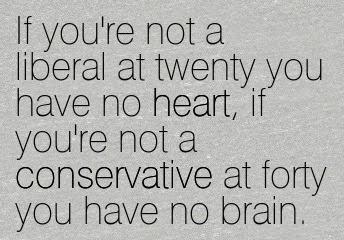
This is actually neither unusual, nor surprising... considering the idiom about age and political ideology.


Battle for Millennials

In order to win the millennial vote, Republicans need to learn a few things about messaging.
  1. Stop moderating our positions.  Period.
  2. Learn how to communicate better.
  3. Reach people where they are at now, not where we want them to be.
  4. Build relationships first.


Continued in Part 3 and Part 4.


Please note: all pictures were found via google image search, all I did was crop and add text.