28 June 2013

Part 1: Morality in politics

In some form or another, the word "morality" is bandied about quite frequently in politics.  What are we even talking about?  Let's clarify a few things.
  • I am a Christian, so don't even start with that about me.  Not only that, I'm a very devout Christian, and well-read and studied in theology.  I was catechised from a very young age, and continue that study to this day.
  • Christians do not have a monopoly on morality, and anyone who tells you otherwise is either a liar or has never read the Bible.
  • A Christian who has read the Bible would tell you that God has written His law on everyone's heart--and that law is what we call natural law.  Those of other faiths, or no faith at all, would tell you this ended up there in a different way, but that isn't the point.  The point, rather, is that everyone knows right from wrong in the physical realm (on the spiritual plane, it is a whole 'nother matter, probably for a different blog).
  • Because Christians don't have a monopoly on morality, the "religious Right" needs to get off their darn high horse and start arguing natural law in politics logically and effectively, rather than with Bible-thumping emotionalism (then again, since emotionalism is the heresy de jour, maybe that's easier said than done...).
Morality certainly has its place in politics, and to deny that is silly and wrong.  However, many seem to confuse morality (natural law) with behavior control (the use of government force, i.e. coercion and/or violence or the threat of violence, to enforce a certain behavioral code).  That is where we run into trouble.

Without getting too much into the theological weeds, let me briefly lay out why I believe it is wrong for a Christian to argue behavior control is the appropriate role of government.  I have already written on this topic on my theology blog, so let me make new arguments here and let you go read my previous post for the rest.
  1. This is a fallen world.  If you accept that premise and understand Original Sin, you know there is no way for humans to not sin while on earth.  No number of left-hand kingdom laws can change or stop sin, and while sometimes they might curb bad behavior, we all know there are those who will just not follow the law anyways.  So why bother having laws at all, right?  Well...
  2. Because governments, theologically speaking, derive their just powers and authority from God.  This authority is very specific, particularly: police and military powers (power of the sword), and laws to keep order (to curb behavior that either encroaches on another person, or breaks your word--the basis of common and contract law, and our understanding of natural law).
  3. The left-hand kingdom, or the kingdom of man, is governed by morals and reason, not faith and Scripture.  Essentially, an atheist, a Buddhist, a Muslim, and a Christian should all be able to cast the same vote based on reason and morals.
Another interesting point that was raised in the Facebook discussion that prompted this series of posts is the nature of morality, and the "lesser of two evils" argument everyone makes in politics.  Accepting the premise that this is a fallen world, all political choices would essentially be a choice between lesser evils.  That is where morality comes into play--meaning who will better understand and uphold natural law, rather than who will enact my idea of behavior control.  

As one of my friends put it, "You speak about morals and then relent that it's the lesser of two evils. Please elaborate on how evil is necessary."  The problem here is that the idea of "morals" being discussed was not morality and natural law, but behavior and/or thought control.  The only way to have morality in government is to enforce natural law, not behavior and thought control.  As soon as you cross that line, then it's fair game for anyone to enforce their idea of behavior, and we get into the regulatory mess we are in today in the United States.  You can't legislate the sin out of people, and that is too often what happens in politics, with liberal progressives trying to curb greed, gluttony, and envy, while conservative progressives attempt to curb lust, and sloth (I'm not entirely sure where, if anywhere, pride and wrath fit into either side's legislative agendas, as it seems a problem both sides have personally...).  That's simply unreasonable.

In summary, morality is natural law (do not encroach on any person or their property, and do all you have agreed to do--the basis for common and contract law), not behavior or thought control.  Until we understand that distinction and start to govern in a way that shows we understand it, we will remain in this mess we have today, and continue to use words that don't mean what folks think they mean.

24 June 2013

Introduction: Morality, the role of a political Party, tools, elections, loyalty... and the kitchen sink.

Wow, you never know what will blow up on Facebook.  I can post deep theological or political missives that get nary a glance, and then post baby pictures with 100+ likes (although, to be fair, my baby boy is adorable).  So when I recently shared my mom's decision to leave the Republican Party (no, she is not registered as a Democrat now, sheesh), I didn't really expect the comment extravaganza that ensued.

Then when I went to write a post about it, I found a post sitting in my drafts from back after the November election talking about almost exactly what I was going to say now.  Apparently there is nothing new under the sun.  I'll be stealing from that post and some of the comments today in order to clarify a few things over the next four posts, because I'm afraid if this is just one post, it'll ramble on for days and no one will want to or be able to read it.  These overarching topics are:
  1. Morality in politics (oh, this is a can of worms in and of itself, because I not only get to insult people politically but theologically...).
  2. What exactly is the role of a political Party, anyways?
  3. Political tools and how those affect elections.
  4. Party loyalty vs. loyalty to principle.

Strap in... it's gonna be a bumpy ride!

Just so you can see what started this all, here is what my mom had to say:
"I just changed my political party affiliation. It's been a long time coming.

Some will try to suggest that it has to do with what happened to my daughter in El Paso County. But people who try to do my thinking for me and try to suppose what is in my mind and heart are usually wrong.

While what happened with Sarah was unpleasant, it is only indicative of the larger picture, which is much more important.

For me, there are two major reasons for the change. One, my understanding of the two kingdoms and how that should play out. And two, my utter disgust of the current two-party system which look to their own needs first. Where are the patriots of yesteryear? Where are the civil servants who serve the needs of their constituents? Where are the people of principle, valor, steadfastness of character, and courage, and above all, liberty-minded?

Why do we think as a society that every aspect of our lives much be governed? The electorate must assume responsibility for continually electing people who don't hold to their pledge to support, protect and defend the Constitution.

For my children, and my children's children, only those who are liberty-minded and Constitutionally grounded will earn my vote."

The simple comment I tacked on when posting it on Facebook was this:
"Those running this fall and next, you've got your work cut out for you. More and more people are getting fed up with the hypocrisy in both Parties and won't be voting a straight Party ticket any longer."

Confession time (and I've said this before on Facebook): I've never voted a straight Republican ticket.  They haven't earned it.  And most people in Colorado, including the OGREs (Old Guard Republican Establishment, for those of you unfamiliar with that awesome term) would be utter liars if they said they never voted for anyone but a Republican.  I would bet you serious money that most didn't vote for Dan Maes in 2010.

Over the next week or so as I have time, look for the next four posts.

27 February 2013

Opinion: What is the role of the State Party?

It appears I'm doing a series on the State Party, specifically the Colorado Republican Party.  That wasn't quite my intent when I started with my post about a week and a half ago, but another needed to be written... and now this one is here.

For those who don't know, on 2 March (this Saturday), the Colorado Republican State Central Committee has a choice between the Status Quo and a much-needed change (not that I have any opinion on the matter whatsoever).  My hope, in this post and the two proceeding it, is to lay the groundwork for why change is needed.

I don't get a vote, but it is the duty of all Republican Party members to let those who do have a vote know where we stand--and that doesn't mean you have to agree with me.  This is our Party, after all.  We should let those who represent us know how we feel, much like we do when we send letters to legislators on bills or testify before committees.  This election affects all Republicans in Colorado, not just those who can vote on it.

But maybe I got ahead of myself with the last two posts.  So let me back up a little bit with this one.

A question I often hear asked, and rarely answered simply, is: "What is the role of the State Party?" or "What is the role of the State Party Chairman?"

To those, I would add another question: "What is the measure of success for a State Party or State Party Chairman?"

To the previous questions, I've heard many answers, from the old and tired "fundraising" to "beat the Democrats at their own game" to "infrastructure" and "networking"... but all of them fall short.  All of them, to be sure, are part of the answer, but the answer is much, much more simple than any of those.  You want to know what it is?

Win elections.

That's it.  No more.  Nothing else.  Fundraising, technology, strategy, infrastructure, networking, ground game, recruiting, training and supporting candidates and staff, etc. are all a part of that, but they aren't enough alone.  They must work together, or we get the failures we've seen since 2004 in this state.  And it still amazes me that a Party supposedly all about individual freedoms and personal responsibility seems to think that a top-down, Denver-centric, one-size-fits-all approach actually works in every state, in every county, in every precinct, and in every race.

When will the National GOP learn its lesson?  When will the Colorado GOP learn its lesson?  Hopefully, this Saturday, at least in Colorado.

As to the second question, the measure of success, the answer is also pretty basic...

The measure of success is if elections were won.

I know, call me crazy.  That's too easy, isn't it?  There's nothing in there about fundraising!  Unfortunately, in Colorado, the Republican Party seems to be in the business of losing elections pretty consistently since 2004.  I don't know about you but I'm getting kind of tired of losing.

I've said it several times, so I probably don't need to rehash the total loses or plugs in the dam across the board again, but 2012 was not a great year for us.  Some of it has to do with how we message.  Some of it has to do with being way behind on the technological times.  It certainly wouldn't hurt if we had actual useable data, and that data was given to the people who need it when they need it.  A lot of it has to do with lacking strategy (or, at least, a strategy that isn't over 30 years old).

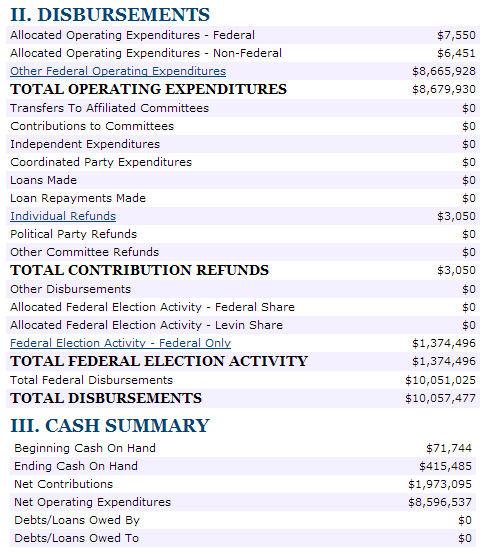
From my perspective, some of it has to do with where we chose to spend money in 2012 as well.  We can raise all the money in the world, but if it isn't put to effective use, it's nothing more than a tool buying our continued losses.

The Colorado Republican Committee summary page on TRACER for the 2012 election cycle, reflecting that $443,453.97 was spend in-state during that election cycle.


This picture and the previous picture are screen captures from the FEC website for the Colorado Republican Committee, reflecting the money spent on Federal (Presidential and Congressional) races and operating expenditures for 2012.

This shows the 2014 cycle (since 1 January 2013) on the FEC Website for the Colorado Republican Committee, reflecting operating expenditures for the cycle so far.

To look at these more in-depth, go to the TRACER website and search for committee number 19991500072, and the FEC website and search for committee number C00033134.

While I understand that Federal races tend to cost more money, are higher profile, and that they are indeed important, the State Party's first responsibility is to the State of Colorado.  We cannot keep sacrificing our state just to lose federal elections.  Colorado can't survive total Democrat rule any more than the country can, but we've allowed that to happen in this state because we focus our time and attention on national races.  Some of this is an education problem--let's face it, the undervote for down-ticket races is huge.  That doesn't make them any less important, as we are learning the hard way with the far-left agenda being jammed down Colorado's throat in the State Legislature right now.

I was recently reminded that we saw the highest delegate badge fees (at least in my recollection) this year, and candidates for President had to pay for the privilege of being on our non-binding straw poll ballot.  I wonder what the hard working and dedicated Republican activists who paid those increased fees think of having hundreds of thousands of dollars left unspent in perhaps the most critical election in the last century, if not our nation's history?  This one is none too happy.

For those who know me, you probably remember the hubbub I caused in El Paso County as the GOP Secretary for daring to disagree with a policy put forth by a State Legislator.  The horror!  You would think if someone did something that relatively minor (I dare you to find me any Republican I agree with 100%--even my husband and I aren't lock-step on policy issues), a Republican County Party Officer donating to a Democrat during his tenure would have gotten at least the same response--scorched earth, character assassination campaign, a gag order, censured... and at the very least, threatened with removal for actually violating the By-Laws in their letter (not just the spirit as folks argued against me), right?

Turns out, not so much.  In 2007, while the Vice Chair of the Denver County Republican Party, Chairman Ryan Call maxed out a contribution to Bernie Buescher, a Democrat candidate for State Representative out near Grand Junction.


My understanding, from talking to many active members of the Denver GOP at the time, is that no sanctioning action was taken, and Chairman Call certainly wasn't removed from office for his violation.  And, in the interest of fairness, Chairman Call then maxed out to the Republican in the race, Laura Bradford--so that makes everything okay, right?  Here's my question... why did he not ask for the contribution to Buescher back, at the very least?

We could move on and forgive an indiscretion, certainly.  It becomes much harder to do so when that rule is then unfairly applied.  This Party, I thought, believes in the rule of law--rules are rules and apply to everyone.  So, in 2010, why were Tancredo supporters not removed from their Party offices (even down to precinct leader)?  Why did Chairman Call take the position he did regarding my censure (on something that did not clearly violate the By-Laws, unlike an out-right contribution to a Democrat), saying one thing in public and another in private?  Why did Chairman Call participate in the removal of three precinct leaders from voting earlier this month at the Eagle County Republican Organizational Meeting... for doing the exact same thing he did, publicly support a non-Republican candidate?

I'm all about everyone getting to vote their conscience, and to support whom they choose--in fact, I encourage it.  I don't believe Party always trumps person (most of the time... almost all of the time, even... but not every time).  But there is a standard for Party officers--and we should hold all to it, or none to it.  It can't be arbitrarily applied.  That, at the very least, creates the appearance of a ruling class and a "rules for thee but not for me" mentality that is dangerous and not very Republican.

And speaking of Denver County... it is my understanding that Chairman Call, when he left the Denver GOP and subsequently became State Party Chairman, left a parting present of nearly $10,000 in debt.  It seems to me ironic that Chairman Call, who frequently makes a point of discussing the debt that the State GOP was in when he took over (and to the credit of those raising funds, was taken care of), left a similar problem for his successor.  Again, this could be overlooked, but from what others have told me, this is a pattern dating back to his days in the College Republicans.  Being hearsay, I won't go into the details shared with me until I can get some physical documentation.  Regardless of whether this is a one-time incident, or a series of unfortunate events, there is great irony considering how Chairman Call begins most speeches I've heard from him recently--that he dug the State GOP out of the same problem with which he left the Denver GOP.

Not that anyone is asking my opinion, but let me offer it anyways: my advise to win elections?  Let's start with don't donate to the "enemy", spend your resources wisely, and don't leave entities in debt.

21 February 2013

Opinion: More failure: Messaging, support, lies and the Colorado GOP

I frequently hear that "social issues are killing the Republican Party."  And while I personally would tend to take the libertarian approach to social issues (i.e. keep the government entirely out of them), I don't agree with that statement at all.  Social issues aren't killing this Party, how we message social issues (and just about everything else) is what is doing us in.

There is a fine line between candidates who get so distracted by everything thrown at them that they can't stay on message, and ultimately lose, and candidates who are so rigidly adherent to talking points they sound robotic, insincere, and fake, and ultimately lose.  Our Party has not done enough to help candidates message in their races, nor do they do enough to help amplify that message.

There are common themes to races at all levels: reducing the size and scope of the government, limiting taxes as much as possible, promoting the free markets rather than government solutions, focusing on the rule of law (not the rule of man), and most importantly, a great emphasis on personal responsibility.  With these themes applicable to everything from local utility board to US President, why has the Colorado Republican Party (and the Republican National Committee) continued to ignore their responsibility to make sure that candidates are well-trained and well-supported?

Under campaign finance law, the Colorado Republican Party is the only entity in this state that can coordinate on a large scale with all Republican candidates.  They can also contribute in much larger quantity to State Senate and House candidates ($20,500 and $14,805, respectively--this number is an aggregate between all political party donations, meaning County, State and National, this is per the SOS website).

What astounds me is not so much that the GOP hasn't gotten their messaging act together (if they continue to insist upon campaigning like it's 1980, why not continue to message like it's 30+ years ago, too?), but some in the Party bald-face lie about supporting candidates.

A current State Republican Party officer said last week at a public event that the reason they had approximately $300,000 left in the bank after Election Day was because they had maxed out to every Republican State House and Senate candidate in Colorado and there was nothing more they could do with it because campaign finance laws tied their hands.  Were it true that they had, indeed, maxed out to every Republican State House and Senate candidate, I can think of plenty they could have done with $300,000 myself, but I digress.  Except it is patently FALSE.
  1. In order to have maxed out to every Republican State House (65) and State Senate (20) candidate at the maximum allowed (assuming the County Parties didn't chip in at all), it would have cost the State Republican Party $1,372,325.  Considering they spent less than half that total in the State of Colorado on non-federal races, that would be mathematically impossible.
  2. A quick TRACER search shows that the Colorado Republican Party only contributed to 12 individual Republican candidates for State House or Senate directly out of 85.  That's only 14% of Colorado Republican State House or Senate candidates.  
  3. In my brief look at TRACER, only two candidates (Brian Watson and Amy Attwood) were given a maximum contribution, with another (Jennifer George) receiving almost a maxed-out contribution.  It looks like 2-3 more may have received the rest of the maximum after County Parties contributed as well.
In other words, very few got a "maxed out" contribution from the State Party, and certainly not all candidates.  

How can we advance any message when we can't even be honest with our Party members?  How are people supposed to trust the message we offer if they can't trust us to be honest about easily verifiable issues?

EDIT:
After a closer review of TRACER, the numbers above have been revised.  12, not 13, individual candidates received contributions directly from the Colorado Republican Committee, totaling $122,962.10.  There were 14 candidates in the "Trailblazers" program, two of which received no direct contributions from the Colorado Republican Committee: Rick Enstrom and  Ken Summers--which, again, pokes holes in the narrative that all Trailblazer candidates received contributions (they may have received indirect contributions, but nothing directly from the Colorado Republican Committee that I can find).

Here are the direct contributions candidates did received (mailers were done for several of these candidates through the "Colorado Republican Party Independent Expenditure Committee" which are not reflected in the numbers below--totaling $85,847.65, which when added with direct contributions only totals $208,809.75--short of the approximately $265,000 that Chairman Call has been saying was contributed to State Legislative Races, I'm unsure where the rest of the money, if there really was more, came from):
  • Cindy Acree, $4,931.22
  • Amy Attwood, $14,805
  • J. Paul Brown, $2,706
  • Larry Crowder, $6,968.13
  • Jennifer George, $14,804.44
  • Ellyn Hilliard, $5,000
  • Dave Kerber, $14,306.64
  • Dave Pigott, $5,000
  • Robert Ramirez, $10,142.90
  • Lang Sais, $19,500
  • Brian Vande Krol, $9,992.81
  • Brian Watson, $14,805
Of those candidates, only ONE won his election: Larry Crowder.  We lost sitting legislators Acree, Brown, and Ramirez, and lost all the other races (Attwood, George, Hilliard, Kerber, Pigott, Sais, Vande Krol, and Watson).

Edit #2: As you can see in the comments below, it has been brought to my attention that both Ken Summers and Rick Enstrom, while not receiving direct contributions from the CRC, took their contributions in coordinated expenditures.  I appreciate the correction, and when I have the chance, I'll take a look at TRACER so the numbers above can reflect this information.

16 February 2013

Editorial: It’s time for the Redprint

Wall Street Journal, 4 February 2013, “Party Eyes 'Red-State Model'to Drive Republican Revival

See that blue splotch in the center just to the left of the middle?  That’s what Colorado has looked like for almost a decade now.  We got “blueprinted” in 2004, and instead of leading the charge to counter the extremely effective model the Democrat Party used with Colorado as the test case, we’ve continued to remain a sickly blue every election cycle since (with the exception of the 1 seat majority in the State House brought on by the Tea Party surge of 2010).  It now takes a state, Kansas, with a supermajority and Republican control of the Governor’s office and both chambers of the State Legislature, to attempt to build a counter to that model—10 years later.

Since it started right here in Colorado, it should end right here in Colorado, but the Republican Party continues to do nothing about it

Why?  Why has the strategy not changed?  Why do we continue to use the same anemic top-down, Denver-centric model for campaigning?  Because there are people in power who benefit from our continued losses—and why not?  They continue to be paid to help us lose, to implement the same strategies that we’ve used for decades (with minor updates) that they think will somehow work again someday.

It’s time for a drastic shift and change in leadership, vision and strategy (all three of which have been entirely absent the last decade in the Colorado GOP).  Colorado is not the solidly-red state it once was.  We can’t continue to campaign like its 1980 and assume we will win like we always did.  Clearly, that isn’t working.  Instead of fixing it, we’ve kept the same model and suffered terribly for it for 10 years.  Enough is enough.

It’s time for the Redprint—in fact, it is long overdue.  After the abysmal showing in 2012, it should be clear to even the most hard-headed that what we have been doing simply isn’t working.  We need vision, strategy and leadership—not platitudes and pandering.  It’s hard to imagine we could do any worse than we did in 2012, and we can definitely do better.  But I don’t think we can do better without change at the top in Colorado. 

Ryan Call is a nice guy—but clearly, he is the wrong guy for this job.  As he said himself in December 2012 (and I’m paraphrasing), it wasn’t his job to lead, but to follow the dictates of the Romney campaign and the RNC.  What did that get us?  Losses across the board.

It’s great that we spent more money on State Legislative races than before, and nice that we raised $2.4 million.  But what did that buy us?  A very cushy salary for Chairman Call (after saying he wasn’t sure if the position should be paid on the campaign trail back in 2011).  Great kick-backs for all the crony political hacks who have ensured Democrat dominance in this state since 2004—people who are supposedly on our side!  Here’s what it also bought us:
  • A loss for Romney in Colorado.
  • A loss in our only statewide election. 
  • No change in Congress (despite a potential pick up in CD7).
  • No change at the CU Board of Regents (when there was one, possibly two, potential pick-ups).
  • No change at the State Board of Education (granted, with only CDs 2 and 4 up, there wasn’t likely to be any change this election cycle).
  • No change in the State Senate (despite 2 very winnable seats, and another possibility or two there).
  • A 9 seat swing in the State House, from 33R-32D to 37D-28R (the largest loss since 2004).

Additionally, Chairman Call guaranteed in 2011 that we would win in November 2012—or our money back.  Listen around the 12:30 mark to hear this pledge.


That $2.4 million raised?  That’s also helping to buy Chairman Call’s reelection.  From using Party fundraising letters and emails to promote his campaign (that is the only reasonable interpretation of several of those) to using Party Staff and resource to “select” Bonus Members to, apparently, using the new Regional Offices to all but bribe votes to refusing to share the contact information for the voting pool with other candidates for Chair, Vice Chair and Secretary, Chairman Call, in an unprecedented misuse of State Party funds and resources, is using your contributions to reelect himself.

If you are a contributor to the Colorado Republican Party, please ask for your contributions back and don’t contribute again until this gross misuse of Party resource is rectified.  This is inexcusable.

In 2011, Chairman Call made a number of campaign promises, including monthly meetings with Tea Party groups, providing needed resources to County Parties, to help County Parties fundraise, etc.  You can read the entire letter here.  To the best of my knowledge, he didn’t follow through on much, if any, of those. 

In the same letter, Chairman Call promises a transparent and accountable State Party, but we don’t even know what his salary is (rumor is that it is anything from $135,000-$175,000/year).  In fact, other than generic items on TRACER and the FEC, we don’t know where any of the $2.4 million raised (and over $7 million given by the RNC, Republican Senatorial Committee and Massachusetts GOP) was spent.  How is that transparent or accountable?

In 2007, while Vice Chair of the Denver County GOP, Chairman Call maxed out a contribution ($400) to Bernie Buescher, a Democrat candidate.  While I don’t have an issue with folks doing this, when you are a Party officer or official of any kind, that is unacceptable.  When he got caught, instead of doing the right thing, he made excuses.  He didn’t apologize, and he didn’t ask for his contribution back.  The explanation I have heard was that Ryan’s employer at the time (John Zackum—State Party Legal Counsel) asked him to, so he did—while they were Republican Party Officials, an offense that would get most people removed from their office (strangely enough, both Mr. Call and Mr. Zackum remained in their respective positions).

The bottom line is, we lost.  We lost badly.  We have not received an acknowledgement of that from Chairman Call, nor have we received an apology—and we’re not likely to.  We can’t keep winning when we keep using losing strategies.  We need a change.  It really can’t get any worse than total losses, but it can get better if we have a real leader focused on strategy and vision.  As nice as he is, that person isn’t Ryan.  For the good of the Party, he should have resigned on 7 November.  But he didn’t, and he won’t.  $135,000/year is an awful lot of money to give up easily, so I understand why he would fight for this—but without results, he doesn’t deserve that salary; he doesn’t deserve the job.

07 November 2012

Editorial: The Aftermath

Or, perhaps better titled... "A Little 'I Told You So' and a Little 'You Were Right'".

After I put out my predictions on Colorado races (especially the Colorado State House), many people went nuts saying I was super pessimistic, only doomsday would bring those numbers, we were going to gain several seats in the House and win the Senate, etc.  Well, some of you were right about one thing... I was wrong on my numbers.  However, I think I've earned the right for a bit of a (maybe even a big) 'I told you so!' because my numbers about the Democrat sweep of the Colorado State House were low, not high.  In fact, of all the electoral prognostications I saw, no one else right-of-center predicted a net Democrat gain in the State House, let alone the near-total sweep that happened (I didn't look at things like Colorado Pols or other places like that, so I don't know what the left-of-center folks were saying).

So what happened?

One word.  REAPPORTIONMENT.

Two words.  Ryan Call.

Three words.  Republican 'Leadership' Vacuum.  (referring to the counties, since State Party is covered previously)

That's my election summary for Colorado.  The party of evil cannot be beaten by the party of stupid, and it's more stupid than usual here in Colorado.  Remedies?

  1. Run the so-called 'leadership' out of town on a rail.  February and March will be upon us before we know it, and we MUST clean our (GOP) own house before we worry about anything else.
  2. Once we have actual leadership, better candidates.  Not these simpering, moderate, big-government boo-hoo Boehner sissy-types, but people who actually believe in liberty and the GOP platform--and aren't afraid to talk about it, advocate effectively, and are actual competent candidates.
  3. We need a long-term strategy.  Living election cycle to election cycle, with a year and a half of down time between elections DOESN'T CUT IT.  At minimum, we need a 10 year strategy in place within the next 6-12 months.  We won't win everything overnight.  We have to be realistic.  But for crying out loud, we need to plan.  Failing to plan is planning to fail.


PRELIMINARY RESULTS

The results will not be official for a while longer, but I don't think (other than possible one race: SD19) that the results will drastically change between now and when the official results are released.  Not enough to change who wins, at any rate.  Below are the winners as of right now from the Secretary of State's results page (I'll add in percents later when they are official).  If they're in bold, I got that race right.  If they are in italics, I got that race wrong.  Not all counties have reported into it yet.


CU Regent
Pre-Election Make-up: 5 Republicans, 4 Democrats
Projected Post-Election Make-up: 5 Democrats, 4 Republicans
Post-Election Make-up: 5 Republicans, 4 Democrats
  • At-Large: Steve Ludwig (Democrat)
  • Congressional District 3: Glenn Gallegos (Republican)
  • Congressional District 5: Kyle Hybl (Republican)
  • Congressional District 7:  Irene Griego (Democrat)
3/4


State Board of Education
Pre-Election Make-up: 4 Republicans, 3 Democrats
Projected Post-Election Make-up: 4 Republicans, 3 Democrats
Post-Election Make-up: 4 Republicans, 3 Democrats

2/2

Congressional
Pre-Election Make-up: 4 Republicans, 3 Democrats
Projected Post-Election Make-up: 4 Republicans, 1 Democrat, 2 toss-ups (my bet is at least one, CD7, goes R)
Post-Election Make-up: 4 Republicans, 3 Democrats
*Quick note on the two toss-up: I never said Kevin Lundberg or Joe Coors would win, only that they could win (and I do have to admit surprise with the defeat of Coors by the numbers I'm seeing).  Under better leadership in this state, they very well may have won, but speculating doesn't get us anywhere.  Bottom line, while I'm surprised by the margin of defeat that Coors suffered, I'm not terribly surprised either district did what it did.  I'm giving myself half credit for each of these, though, to be fair.

6/7


State Senate
Pre-Election Make-up: 20 Democrats, 15 Republicans
Projected Post-Election Make-up: 16 Democrats, 15 Republicans, 4 toss-ups (my guess is it goes 2 and 2 for Republicans and Democrats)
Post-Election Make-up: 20 Democrats, 15 Republicans
*Okay, on this one, I was wrong.  I actually thought Lang Sais would win outside the margin of an automatic recount.  While this race is within the margin of automatic recount now (I believe 332 votes are separating them), I'm not sure that Lang can make up that many votes.

**Partial credit to me on this one for leaving it a toss-up and not doing with it what I did with SD19, because I thought about it originally.  I am a little surprised that Newell won, to be honest, but not totally shocked.

***There are two counties yet to complete reporting in this race according to the SOS site, and about 1,000 votes separating Crowder and his opponent, so it may tighten, but I don't think he'll end up losing.

18.5/20


State House
Pre-Election Make-up: 33 Republicans, 32 Democrats
Projected Post-Election Make-up: 30 Democrats, 28 Republicans, 7 toss-up (my very unscientific prediction is all but 1 or 2 go Democrat based on district performance and/or active voter registration numbers, and what I know about the district and candidates)
Post-Election Make-up: 37 Democrats, 28 Republicans
*Not giving myself any credit for it, but I was right that Ellyn Hilliard did have the largest number of votes for a Republican in Boulder State House races.  Just sayin'.

**Partial credit for this one since I gave no clear prediction.

***My bad for not making this one a toss-up, I was truly surprised that J. Paul Brown lost that district with the numbers I saw.

****My only surprise in this race was Kathleen Curry not getting more votes than she did.

I'm not really surprised by any of this (other than J. Paul Brown losing, that one did catch me off guard), but I am somewhat surprised by the margins I'm seeing.  For example, I expected Robert Ramirez to lose, but not by near 10%.  Just goes to show the power of reapportionment.

63.5/65


FINAL RESULTS

Bottom line, reapportionment really shanked us.  I was overly-optimistic about the State Senate, and under-pessimistic about the State House.  Finally tally?

Out of 94 races in which I predicted an outcome, I only got 3 out and out wrong; 4 races I characterized as toss-ups (either not making a clear predictions one way or another, or which I called as "leans" the wrong way (but still kept it as a toss-up).  That equals a 96.81% accuracy rate.  Not too bad for relying solely on the three things I have always found to be the most reliable indicators in politics:
  1. Active Registered Voters,
  2. Past District Performance, and
  3. Good ol' gut instinct (which is largely based on knowing many of the districts and candidates).
No polls, no "how much money was raised", no gimmicks.  Just saying, folks.  Just saying.

Oh, and I more than once predicted Obama would win Colorado.  In fact, that was the best possible thing (well, actually, the best possible thing would have been Obama winning Colorado but losing nationally), because that is a slap in the face to the Ryan Calls and Eli Bremers and other GOP hacks of the world.  Guys, you didn't win it.  You and your ilk have now fudged up what should have been two wave Republican years (2010 and 2012), and you still haven't gotten it through your back-room, smoke-filled brains that we can't fight the party of evil with your brand of stupidity and lack of strategic vision.  

Maybe the rest of the Colorado GOP will now get the hint to make that kind of Republican 'leadership' extinct.  This isn't about radically changing the Party, this is about using common sense, a solid platform actually adhered to by candidates, and basic political strategy to actually... you know... win elections.  Liberty is a winning message, guys.  Get on the bandwagon or get off at the next stop (heck, we might even throw you off before we get to the next stop depending on how you respond to this repudiation of your inability to "make Colorado red again").

14 October 2012

The "United States is" vs. "United States are": A step towards socialism/progressivism

Regardless of one's opinion of the Civil War, the one thing that most liberty-lovers can agree upon is that one outcome of the North's victory was a major shift in the way people, both at home and abroad, spoke about the United States.

Gone are the days of the primacy of the several States over a limited Federal Government, and in their place, the Federal Government grew.  No longer were the United States referred to as a plural collection of several states, but a singular, "unified" federal-centric nation.

  • The "United States are" = individual states joined in a union with constitutionally limited federal power 
  • The "United States is" = increased federal power and decreased state sovereignty

Perhaps worse, during this shift from plural to singular, it became the predominant view of the Federal Government and the majority of citizens alike to see the states not as sovereign entities, but rather as mere administrative divisions of the central Federal Government.

I believe that this change in thought is what helped pave the way for the "progressive" amendments to the Constitution in 1913 (the 16th and 17th Amendments), and has allowed for creeping socialism ever since--because most citizens now think of the country as a Federal Government that has primacy over the several states, rather than the proper balance: the several sovereign states as the "incubators of democracy", with a Constitutionally limited Federal Government.

05 October 2012

Top 10 Republican and Democrat Counties in Colorado

Based on numbers from the Colorado Secretary of State's Office (accurate as of 1 October, 2012), here are the top 10 counties by percent of active Republicans and Democrats within the county.  Now you'll know where to move to--or avoid--based on the concentration of Republicans or Democrats in a particular county.

I find the disparity between Republicans and Democrats congregating together to be interesting--when averaged, the top 10 Republican counties come out to 65.38%, whereas the top 10 Democrat counties come out to 51.96%.  Apparently Republicans like living around other Republicans more than Democrats like living around other Democrats.

Other interesting food for thought: Arapahoe County has the 3rd most registered active Republicans AND 2nd most registered active Democrats in the state (94,971 and 94,695, respectively).  I'm sure this is why it is a swing county.

Maybe now I need to do top 10 best performing Republican and Democrat counties.  That could be fun and illuminating... but, without further delay, the numbers for this post...

Republican

10) Kit Carson -- 59.94%
9) Phillips -- 60.14%
8) Lincoln -- 61.12%
7) Moffat -- 61.73%
6) Custer -- 61.99%
5) Hinsdale -- 63.52%
4) Cheyenne -- 66.7%
3) Rio Blanco -- 72.49%
2) Washington -- 72.79%
1) Jackson -- 73.42%

(Note: El Paso County has the most total active registered Republicans, at 132,755--but only 46.59% of the registered voters in El Paso are Republicans, which is why they didn't make the list)


Democrat

10) San Miguel -- 45.07%
9) Mineral -- 46.81%
8) Pueblo -- 47.1%
7) Saguache -- 49.29%
6) Huerfano -- 50.01%
5) Denver -- 50.79%
4) Conejos -- 51.68%
3) Lake -- 51.9%
2) Las Animas -- 54.79%
1) Costilla -- 72.17%

(Note: Denver County, no surprise here, has the most total active registered Democrats, at 152,176, and you'll notice them on the list at number 5)

04 October 2012

Opinion: Debate Analysis

It was obvious to even the non-objective observe that Romney won last night.  Obama almost didn't even bother to show up.  Maybe if he brings his teleprompter next time, just because he's so used to seeing it, it will help him psychologically to be more "in the zone" (not that we really want him to be).  It's no big secret that Obama is not a great speaker, he's a great reader.  Or maybe he speaks well, he just can't impromptu.  At all.

Romney had some great moments.  He had a few good zingers, at the beginning especially (bring up the "middle class has been buried" line was inspired).  He made excellent points on things like the debt not just being an economic issue, but a moral one, and that $90 billion of subsidies to bankrupt energy companies (all but one I believe are now bankrupt, but don't quote me on that) was like 50 years worth of subsidies (my personal favorite line of the night--his later point about that being able to hire 2 million teachers I thought was much weaker).  He seemed much more solid and alive than I've ever seen him this campaign.

Romney also had some bad moments.  Let's be honest--and hope he gets better before the next debate.

Areas to improve on or watch for next time:
  • When Obama lies, don't whine about it ("But... but... but... he LIED about my economic plan!" sounds like a 5 year old, not a Presidential candidate).  It's not like it surprises anyone on our side of the fence that Obama lies, and that would have been a great time for a joke, not a whine. 
  • Be careful not to cross the line between being strong and not letting the media/moderator run roughshod over you and coming across like a jerk.  I think Romney came awful close to that line last night, so he needs to watch that carefully.  On the plus side, I was pleased to see him actually appear to have grown a pair and was glad he kind of took charge there.
  • Do not cave on things like regulations, taxes and getting the federal government out of things it doesn't belong in (like healthcare and education).  Romney really worried me with his statement about how the free market can't exist without regulations, and his repeated statements about not actually wanting to lower taxes (he usually meant, I think, to the point where it adds to the deficit, but didn't always add that in) or get rid of regulations or keep parts of Obamacare (which should NOT be a federal issue in the first place) or that the Federal Government should help out with education at a state level (again, so NOT a federal issue) are very troubling.
  • Romney must get a better answer on the Obamacare vs. Romneycare issue and stop saying repeal and REPLACE.  It should be repeal and repudiate, then repeal all the federal regulations that are causing price spikes in healthcare.  Even with Obama barely there, Romney lost that section from what I saw.  He has to get stronger on that, and quickly.
  • What struck me as odd last night was Romney's attempts to make his positions sounds like Obama's on several issues, and then have Obama be the one trying to draw distinctions.  Usually, it is the other way around.  I didn't like that approach and hope it is never used again.


Overall, even with areas to improve on, I thought Romney did surprisingly well--certainly much better than I expected, to be perfectly frank.  I also really liked the format of this debate as compared to previous Presidential and primary debates.

A brief note now on "independents" and the "audience" for the debate:
  • Most people who claim to be "independent" or are registered that way are NOT middle of the road, no matter how much they tell you that.  A significant portion always vote for one party or another, they simply don't want to be affiliated with a party for whatever reason.  Anyone who says otherwise is probably lying.
  • Most Republicans who left the party to become independents didn't do so because they wanted the GOP to be more "liberal", but because it wasn't conservative enough, or pro-liberty enough.  Pandering middle of the road-to-left in a general election, therefore, further alienates that voting block--and Romney is going too far left for many of them, from what I've been hearing.
  • Debates don't win elections.  Most people have their minds made up by now, even if they don't want to admit it.  Most people either don't like Romney or Obama, but the "undecideds", based on my experience, are largely looking for a reason to vote for Romney or Obama, not just against the person they don't like.  People watch the debates to get a positive reason to vote, and I'm not sure that last night's debate did that for either candidate.  Yes, Romney came across strong for the first time, and yes, he obviously won.  But he also said some very troublesome things about the free market, taxes, regulations, etc.  Wanting to save parts of Obamacare doesn't help him, either.  Obama totally not showing up certainly didn't help him.
  • Finally, who watches these debates?  Honestly, it's largely the wonks and people who have already made up their minds (how many Romneyites or Obamaheads were tweeting/blogging/facebooking/commentating last night?  LOTS...).  Any arguments that Romney "had to" go left because of the audience is just plain naive.  Additionally, no candidate should ever change their message because of the audience.  How it is presented, yes--absolutely.  But never the content of the message.  Romney can't say he want to cut taxes on the campaign trail just to turn around in the debates and say... well, not really, and many other things that sounded to me like contradictions.  Flip-flopping, or at least appearing to, will not win you an election because it erodes trust.

11 June 2012

“A Marriage of Athens and Jerusalem…”


I normally try very hard not to cross the streams of the left and right hand kingdoms, mostly because I am just as passionate about theology as I am about politics and am probably just as polarizing in both realms, but here goes nothing.

I took a brief hiatus from Party politics last week to attend the 49th Rocky Mountain District Convention for the Lutheran Church-Missouri Synod 7-9 June in the Denver Tech Center.  This was quite unexpected.  At our May voters meeting at Church, I was elected as a last-minute alternate to replace our other alternate who had a conflict arise, just in case our delegate couldn’t make it.  No one else volunteered, so I did.  Our Delegate swore up and down that he would be there—and I know it would have taken an act of God to keep him from it.  Which is what happened.  Those incredible rains came last week in Colorado Springs, and late Wednesday evening, I got an email from him informing me his house had flooded and he couldn’t make it.  Our Pastor’s house flooded, as did my mothers.  All three live very near each other.  So I, living in Denver now, ended up attending as our congregation’s voting delegate.

After a little kerfuffle with the sign-in (I was so last-minute my paperwork wasn’t there, and because my Pastor, who is the District Secretary, had a flooded house, he was delayed in getting to the convention), the fun began.

Without getting too much in the minutia of the theology of the Lutheran Church-Missouri Synod, let me give a brief overview for those who aren’t too familiar.

We are a creedal church, meaning we confess the Ecumenical Creeds (Apostles, Nicene and Athenasian).  We believe in Faith Alone through Grace Alone by Scripture Alone.  We believe that the Bible is the infallible Word of God.  We are a sacramental church, which means we actually value the saving properties of Baptism and Holy Communion (which we believe in Real Presence, which means that the Body and Blood are in, with and under the elements—not transformed into, nor merely representing).  The Book of Concord is our confession of faith, and is entirely based upon and in accordance with Scripture.  We hold tradition and history to be important, but not on the same level as the Bible.

Anyone who wants to know more may certainly ask.

Now, as with party politics, there are essentially two sides in our synod.  The “confessional” side, the Quia subscribers to the Book of Concord (“Quia” is simply Latin for “because”, meaning that we believe in the Book of Concord because it is supported by Scripture, indeed, in full support by Scripture), are all very conservative.  The liberal side, the Quatenus subscribers to the Book of Concord (“Quatenus” is Latin for “insofar as”, meaning that they believe in the Book of Concord only insofar as it is supported by Scripture), are the folks who promote things like ordination of women and contemporary worship.

I am just as conservative in my church politics as I am in my party politics.  In fact, on Facebook, I identify myself as a “Confessional Quia Reformed Catholic”.  Originally, the word Lutheran was a pejorative used to try and convince others that those subscribing to the Augsburg Confession were following a man, not God, so while it is an identifier now, I prefer to not use it when at all possible.  When not using it as a title, I also specifically use small “c” catholic (like my many rants on “l” vs. “L” libertarianism) because it refers to the church universal, not the Roman Catholic church.

Hopefully that helps give you a foundation to understand where I’m coming from religiously now, so that the rest of this makes a little more sense.

I hope sometime soon to have the chance to expand this more, but for now I am just throwing out some notes I made during the convention.

·         Confessional Lutherans seem to have a slightly small “L” libertarian tendency—this, largely, I think is due to our strong left-hand, right-hand kingdom doctrine (one that, interestingly enough, Kevin Miller—a non-Lutheran—used as the basis for his book “Freedom Nationally, Virtue Locally or Socialism”)

·         Lutherans really do just have more fun.  How many other church bodies can you think of where you can sit down with your Pastor, the President of the Synod and your husband… drink whiskey, smoke cigars, listen to U2 (on the iPhone of the Synodical President) and talk left-hand kingdom politics?  I dare you to find me one.

·         Speaking of our Synodical President, Matt Harrison… you might know him as the man who kicked serious butt testifying before Congress earlier this year on HHS rules.  If you missed it, it is so worth it to watch/read (various video, audio and statements can be found here).  Find me another church body that, on their website, implores their members to actually study the Constitution (“Learn about our rights under the U.S. Constitution to freely exercise our beliefs and to speak of Jesus Christ and our conscience in the public square.”).

·         There was a huge political emphasis at this convention.  Colorado Right to Life was present with a table and petitions to take to churches.  The banquet speaker (which I missed due to a previously-scheduled conflict) was the National Right to Life President—a Missouri-Synod Lutheran, I might add.  Tim Goeglin was one of the session speakers.  Even during President Harrison’s address the opening night of convention, a few political questions were asked.  This is a church body that, more than most I can think of, is engaged in and understands public policy and the left-hand kingdom.  I’m glad they are getting more engaged as Pastors, as we only have 6 LCMS Congressmen right now (one of them is our own Cory Gardner, though!), and I think that may be changing soon.

·         On a less political note, Colorado has some absolutely incredible confessional Pastors.  It was such a blessing and salve for my soul to be around God’s servants who preach, teach and confess everything I hold dear.  For too long, we’ve been fighting against the infiltration of liberalism into our Synod (anyone who knows me knows that I refer to the ultimate outcome of Seminex, the formation of the ELCA, as the E?CA, because they’re not Lutheran but I don’t know what they are…), and I am so pleased to see a marked return to our confessional roots.  In speaking to several there, it appears this is a pretty drastic shift from even 10 years ago.  I couldn’t be more pleased.


Now, for a few thoughts on the parallels I saw there between the GOP and the church politics.  Maybe I’m just reaching.  I’d love your input on whether or not I’m crazy or if there are the actual parallels I’m seeing, particularly from those who were in attendance.

Topic
GOP
LCMS
Declaration of Independence/Bible (conservatives)
Our ‘roadmap’ for the founding of this nation given to us by our founding fathers
The ‘roadmap’ for the foundation of Christian life and doctrine, given to us by our Lord
Declaration of Independence/Bible (liberals/progressives )
Worth reading, but an old history lesson
Worth reading, but not always right
Constitution/Confessions (conservatives)
Sacred, means today what it has meant always, unchanging
Sacred, means today what it has meant always, unchanging (quia, because the Word of God is unchanging)
Constitution/Confessions (liberals/progressives)
A living, breathing document, can change over time to mean whatever we want it to mean
A living, breathing document, can change over time to mean whatever we want it to mean (quatenus, because the Word of God is not sacred and can be reinterpreted to “fit the times”
Conservative
Traditional, “old-fashioned”, time-tested principles with a focus on actually retaining and promoting those principles of governance
Traditional, “old-fashioned”, time-tested principles with a focus on actually retaining and promoting those principles of faith
Liberal/progressive
Focused on growth and unconstitutional practices to gain the illusion of more power, principles can and are sacrificed in order to obtain more power
Focused on growth and extra-biblical practices to gain the illusion of more power, principles and doctrine can and are sacrificed in order to obtain more ‘power’

Like I said, maybe I’m reaching, but the parallels are pretty obvious to me.  The fight of principle vs. the illusion of power is alive and well in the GOP, and appears to be in my church body too, which of course means I just can’t sit idly by, I must engage in this battle.  Party politics is important, and I will likely be engaged in it for the rest of my life.  But church politics… that is of eternal importance, and so I can’t be uninvolved any longer.  I’m looking forward to the 2013 Synodical Convention now.

Let me be clear… this is not the time or place to debate me on religion.  Comments like that will be removed because they have nothing to do with this post.  Notice I didn’t evangelize in the least here, I’m simply talking about my faith and am looking mostly for input from those who share it (meaning all of Christendom, not just Missouri-Synod Lutherans).  Don’t attempt to evangelize me on your beliefs or lack thereof here.  We can do that another time.  Just talk to me on the elements here.  Thanks!

Oh, and one last comment—that was the best run convention I’ve ever seen, bar none.  Somebody there knows Robert’s Rules of Order pretty darn well (actually, I think most of the attendees knew RROO pretty well, which helped significantly).  There were a few nit-picky things I noticed, but not enough to really even bug me.  The GOP could learn a thing or two (or ten) from them on how to run a meeting.